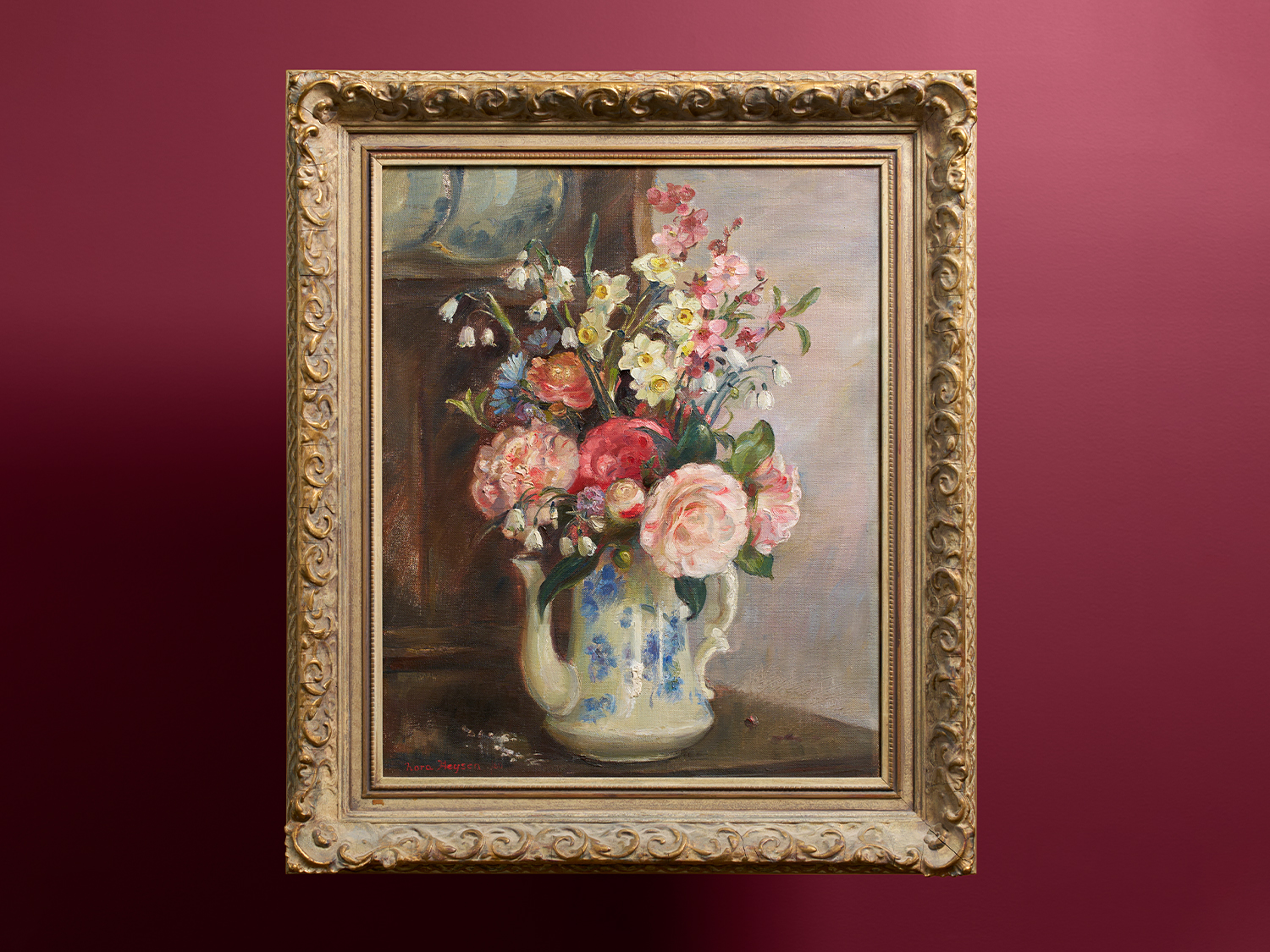
As we are approaching our annual Women Artists auction, I wanted to use this opportunity to write about a significant female trailblazer of Australian art. Nora Heysen (1911 – 2003) was a pioneering artist and a strong persistent voice in a then male dominated field. The artist, born in Hahndorf, South Australia, was the fourth of eight children born to the celebrated landscape painter Hans Heysen and his wife Selma.
Hans Heysen (1877–1968) was and still is one of Australia’s most admired artists and a central figure in the development of Australian art. He is renowned for his watercolours and paintings of the Australian bush, particularly the towering gum trees of the Adelaide Hills and Flinders Ranges.
The family lived and worked at The Cedars in Hahndorf, a large property Hans Heysen purchased to help preserve the Australian bush from widespread tree clearing. Although born into one of Australia’s most prominent artistic families, Nora was determined to establish her own identity as a painter. While her father encouraged her to work in watercolours, she preferred oils, believing the medium better suited her artistic vision. She developed a distinctive style of her own and deliberately chose subject matter that differed from her father’s celebrated landscapes, focusing instead on portraiture and still life.
The desire for independence was evident from an early stage in her career. “At one time she was concerned that people might be asking for her work only because of the Heysen name, so she signed several flower pieces ‘NORAH’, sent them home and asked her father to show them to the dealers.”¹
Following her first solo exhibition in Adelaide in 1933 including portraits, still life, and drawings, Heysen travelled to London from where she immersed herself in European art and culture. Encounters with artists such as Orovida Pissarro, granddaughter of Camille Pissarro, broadened her artistic outlook and influenced her evolving approach to colour and composition. Here she started developing her distinctive style of vibrant colour and form.
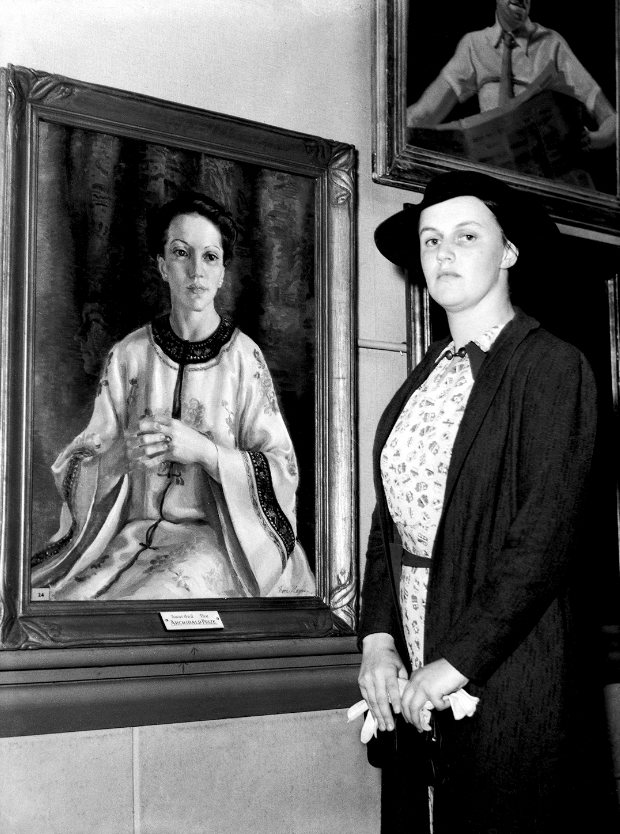
After returning to Australia in 1938, Heysen settled in Sydney and quickly established herself as a leading portrait painter. One of the defining moments of her career, and indeed Australian art history, came when she became the first woman and the youngest artist to win the Archibald Prize for her portrait of Madame Elink Schuurman. Nora was drawn to her sitter’s striking appearance and elegance, qualities well suited to her refined style of portraiture.
The significance of this achievement cannot be overstated. The Archibald Prize had been established in 1921, meaning Nora became the first female winner after 17 years of male recipients. To date, only 13 women have won the prize, accounting for 15 victories from 105 awards. Equally revealing is the fact that out of those 105 winning portraits only 18 depict female sitters.
Heysen continued to break new ground when, in 1943, she became Australia’s first female official war artist. During the Second World War she travelled to New Guinea, Morotai, and Borneo, producing portraits and studies of Australian service personnel. Her work differed from much of the military art produced by men, which often focused on military activity and battle scenes. Instead, Heysen’s paintings frequently emphasised the human experience of war, capturing resilience, vulnerability and everyday life.
The statistics again highlight the significance of her appointment. 16 artists documented the First World War, none of them women. During the Second World War, 35 artists were commissioned, yet only three women were appointed; Nora Heysen, Sybil Craig, and Stella Bowen. In the decades that followed, female representation improved, with artists such as Wendy Sharpe, eX de Medici, Lyndell Brown, and Megan Cope contributing to Australia’s ongoing tradition of official war art.
Following the war, Heysen continued to exhibit while balancing her artistic career with family life after marrying Dr Robert Black in 1953. Retrospective exhibitions in South Australia and Sydney during the 1980s reaffirmed her important contribution to Australian art.
Nora Heysen’s legacy endures through a body of work distinguished by elegance, technical accomplishment, and quiet determination. Her portraits reveal strength and character, while her still lifes reflect a more contemplative side of her practice. The independence, confidence, and sensitivity that defined her life remain evident throughout her work. Nora Heysen opened doors for future generations of women artists and secured her place among Australia’s most important twentieth century painters.
References
1 Klepac L., Nora Heysen, The Beagle Press, Sydney, 1989, p. 13
Speck C., Beyond the Battlefield, Reaktion Books, London, 2014
Australian official war artists | Australian War Memorial Accessed online 20/06/2016
Archibald Prize | Art Gallery of NSW Accessed online 21/06/2016
Nora Heysen | Art Gallery of NSW Accessed online 21/06/2016
By Wiebke Brix, Head of Art
Top Image: Nora Heysen (1911-2003) (Still Life) 1960, oil on canvas, signed and dated lower left: nora Heysen | 60, 55 x 45cm. $20,000-25,000. The Hunter Collection, Adelaide. Thence by descent.
August 2026