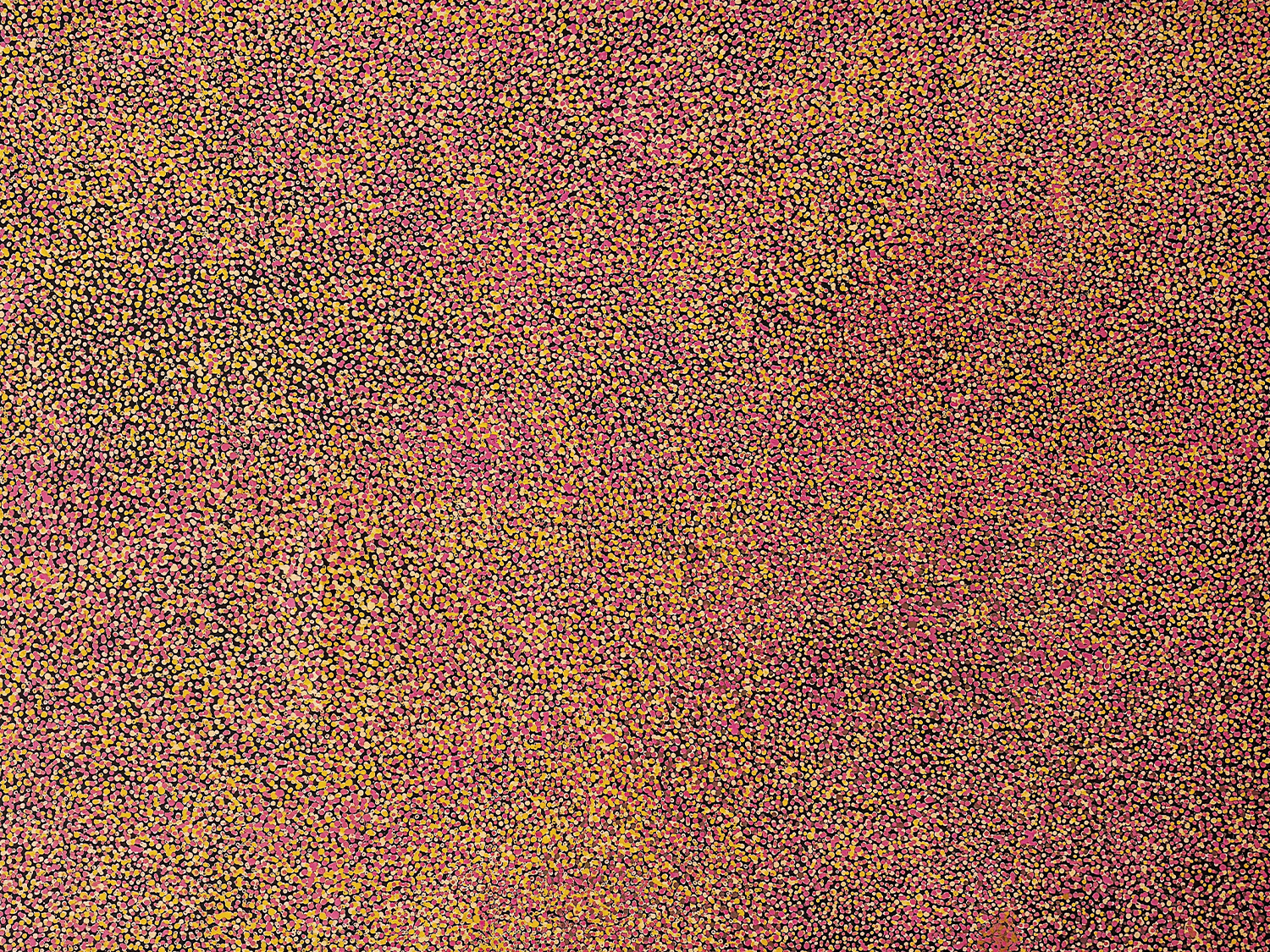
Recently, three Australian landscapes arrived in the art department to be catalogued and researched for auction. Looking at them together, I was struck by just how distinctive the representations of the Australian landscape can be. There is no single way of seeing this country, and yet each view is intrinsically intertwined with the place that inspired its creation.
Australian artists have, of course, inherited and responded to a long European tradition of landscape painting. Artists such as Arthur Streeton travelled between Australia and Europe, painting both environments, while successive generations of artists have continued to negotiate what it means to represent a landscape that looks and feels quite unlike anywhere else.
Perhaps what interested me most about these three works which are by Russell Drysdale, William Delafield Cook, and Emily Kam Kngwarray was that each found a personal visual language for the Australian landscape.
Landscape is the most readily available subject an artist can find. It requires no model, no elaborate staging. It simply exists around us. Yet the persistence of landscape throughout the history of art suggests something deeper than convenience.
We seek out landscape ourselves. We travel to beaches and mountains, walk through forests and escape cities in search of places where the presence of the nature is greater than our own. Perhaps this desire has become even more pronounced as our lives become increasingly technological. Nature offers something our constructed world cannot; space, silence and an opportunity to reconnect with ourselves.
In Australia, that experience has a particular dimension. This is an immense continent occupied by a relatively small population. Australia has a population density of just 3.6 people per square kilometre, compared with approximately 34 across Europe.¹ There are vast places where the horizon seems almost uninterrupted by human presence. Perhaps this helps explain why emptiness, distance, and space have become such powerful elements within Australian art.
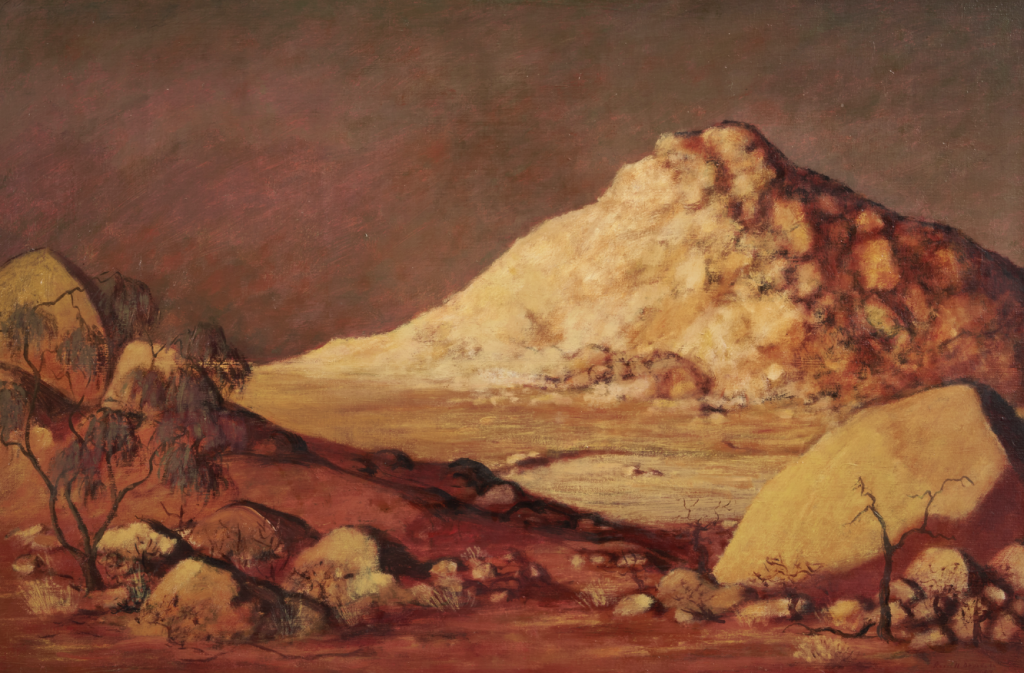
$180,000-220,000. © Courtesy of The Estate of Russell Drysdale, 2026
For Russell Drysdale, a journey through drought affected inland Australia in 1944 proved transformative. He encountered the parched plains, exposed rock formations, and skeletal vegetation that would remain central to his work for decades. As Drysdale continued to travel through the outback and far north, his understanding of the landscape became more complex. He engaged with Indigenous communities and became increasingly aware of their displacement from Country as mining and agriculture pushed further into remote Australia.² Drysdale developed a distinctive visual language for the vastness and strangeness of inland Australia, capturing not only its physical character, but a landscape carrying histories far deeper and more complex than its appearance alone.
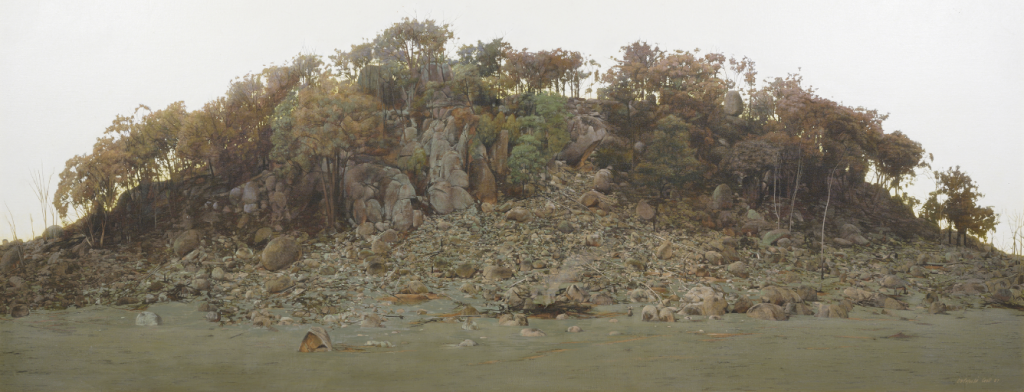
William Delafield Cook’s relationship with the Australian landscape was quite different. Although he made his home in England, Australia remained the landscape he wanted to paint. On his regular returns to Australia, he travelled extensively, gathering photographs and sketches of places to which he felt particularly drawn to. Back in his London studio, he would spend months painstakingly reconstructing these places. For Delafield Cook, painting Australia was explicitly personal. It encompassed his childhood, memories, sense of place and where he felt he belonged.³
Looking at his extraordinarily detailed landscapes, I cannot help but imagine that the slow, meticulous process itself offered a kind of stillness: months spent absorbed in a landscape that, for him, represented home.
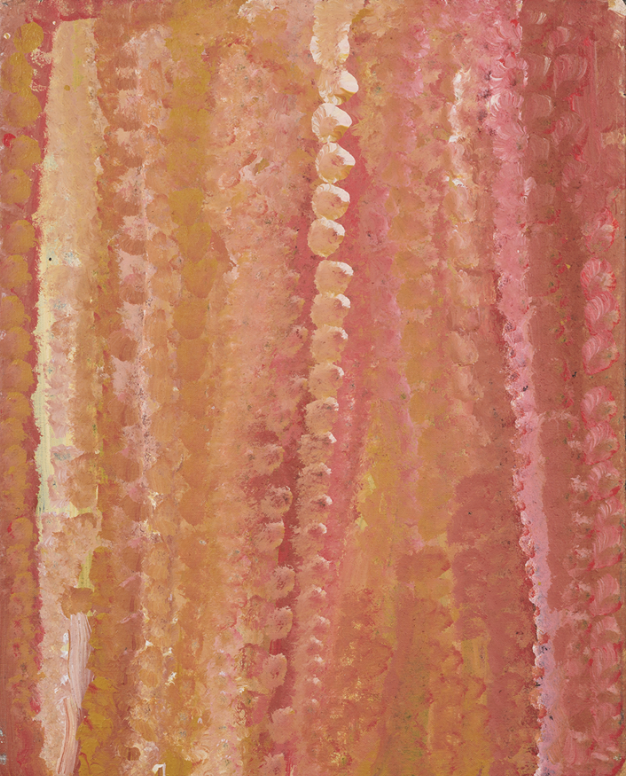
For Emily Kam Kngwarray, Country cannot simply be understood as scenery or something observed from a distance. Her painting emerged from a profound cultural and spiritual relationship with the land. Deborah Edwards described Kngwarray’s technique as embodying her sense of the “explosive, yet ordered, rhythms of the natural world.”⁴ There is something simple yet considered in her mark-making. Repeated gestures accumulate across the surface, creating rhythm and movement, but also an extraordinary sense of calm. There is a meditative quality to the act itself; the physical repetition of mark after mark, painting close to the ground, immersed in Country. The process and subject seem almost inseparable.
What unexpectedly connects these three artists for me is that they did not simply record what was in front of them. They found within the land something personal; memory, identity, belonging, culture, and spirituality. Their landscapes could only have emerged from this continent, yet they remind us of something universal. We do not simply look at a landscape. We form relationships with it, carry it with us and, sometimes, understand ourselves through it.
1. Australian Bureau of Statistics, Regional Population, 2024–25, population density at June 2025; United Nations, UN Data, Europe, 2025 population and population density. (https://www.abs.gov.au/statistics/people/population/regional-population/2024-25, accessed 23 August 2026)
2. Fry G., Russell Drysdale, The White Blow, Leonard Joel, October Fine Art catalogue, 2026.
3. Cotter J., William Delafield Cook, Hillside, Euroa, Leonard Joel, October Fine Art catalogue, 2026.
4. Edwards D., in Tradition Today: Indigenous Art in Australia, Art Gallery of New South Wales, Sydney, 2014 (artgallery.nsw.gov.au/collection/artists/kngwarreye-emily-kame/, accessed 23 August 2026)
By Wiebke Brix, Head of Art
Top Image Detail: Emily Kam Kngwarray (c.1910-1996) (Language group: Anmatyerr) Summer Awelye 1991, synthetic polymer paint on linen, 130 x 220cm. $200,000-300,000. © Emily Kam Kngwarray/Copyright Agency, 2026
October 2026