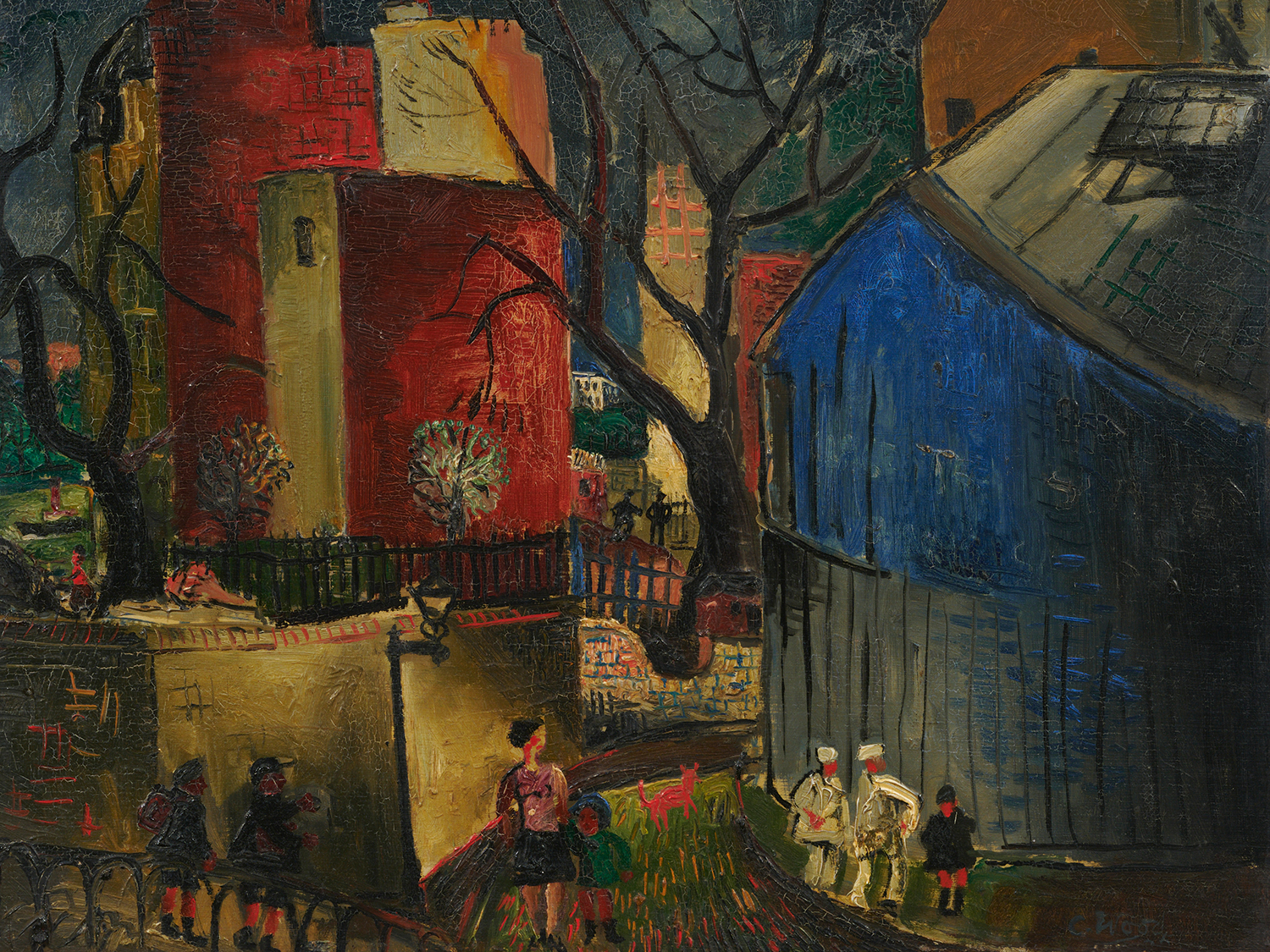
Christopher Wood’s career lasted barely a decade, yet his paintings occupy a distinctive place in British modernism. Born in Liverpool in 1901, Wood initially studied architecture and medicine before moving to painting, encouraged by the Welsh painter Augustus John.1
In 1921 christopher wood travelled to Paris and enrolled at the Académie Julian, beginning a relationship with the city that would profoundly shape his artistic development.2
Paris introduced Wood to the international avant-garde. While moving between Paris and London, he encountered artists such as Jean Cocteau and Pablo Picasso, as well as Sergei Diaghilev, for whom he produced set designs for the Ballets Russes production of Romeo and Juliet in 1926, although they were never used.3 Despite the influence of Paris, Wood was never simply a British supporter of French modernism, as his work absorbed the lessons of Post-Impressionism and modernist simplification while retaining an instinctive, almost naïve directness that became increasingly characteristic of his style.
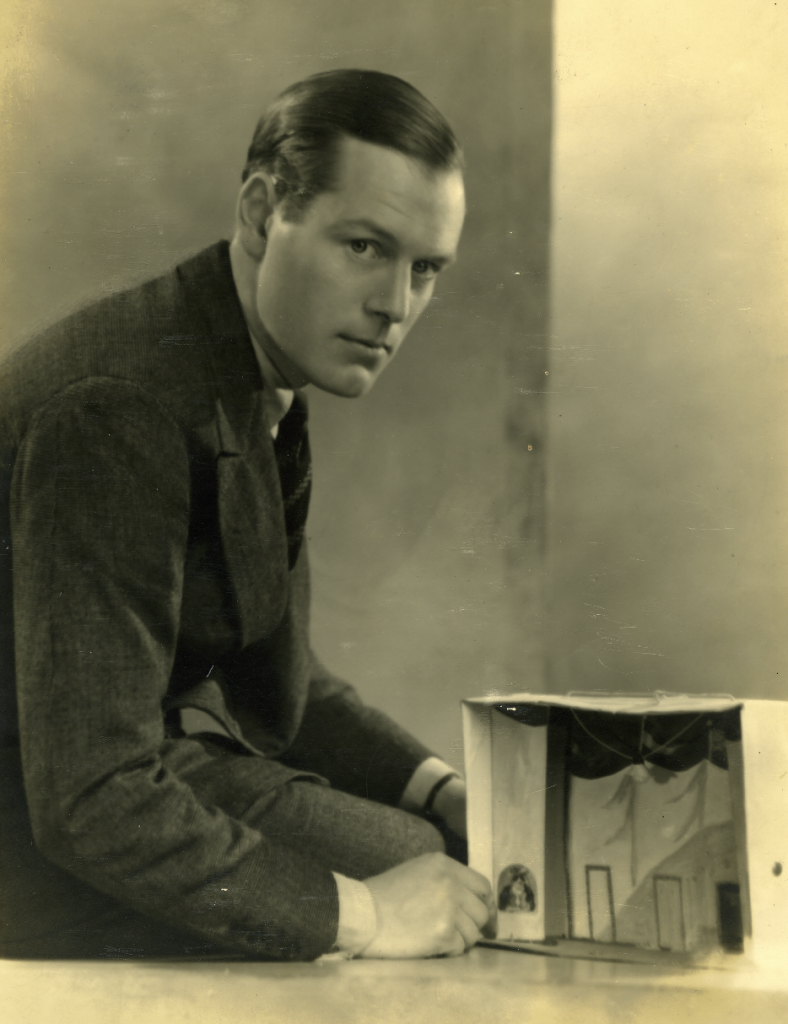
The painting titled Paris offers a particularly vivid expression of this synthesis of styles. The composition is dominated by intensely coloured blocks of architecture, including crimson red, greens, and deep, midnight blues. Dark, twisting trees cut across the buildings, flattening out the space and creating a theatrical framework. At street level, small groups of figures animate the lively scene of Paris after dark. The figures’ scale is deliberately subordinate to the architecture, yet they give the painting its sense of everyday life. Wood’s depiction of Paris is less a conventional cityscape and more a psychological landscape. Perspective is compressed, forms simplified, and colour becomes expressive. The red façades seem to glow against the dark, blue-grey atmosphere, while the large blue building on the right creates a dramatic counterweight.
In paintings such as Paris, the city is both real and imagined. The buildings are solid, its figures recognisable, and the trees are firmly rooted in the street, however, Wood’s colour and compressed perspective transform them into something more elusive. The result is a painting that feels less like a record of Paris and more like a memory of it, one that is vivid, fragmentary, theatrical, and dynamic.
This combination of directness and sophistication places Wood within the remarkable circle of British artists who were redefining painting during the 1920s. His friendship with artists such as Ben and Winifred Nicholson was particularly significant. In 1926 he joined the Seven and Five Society and the London Group, then a year later, he exhibited with the Nicholson’s at the Beaux Arts Gallery (April – May 1927), becoming close to them personally and professionally.4 Whilst on a trip to St Ives, Wood and Ben Nicholson encountered the self-taught painter Alfred Wallis, whose simplified forms and instinctive approach to painting had a profound influence on both artists. 5
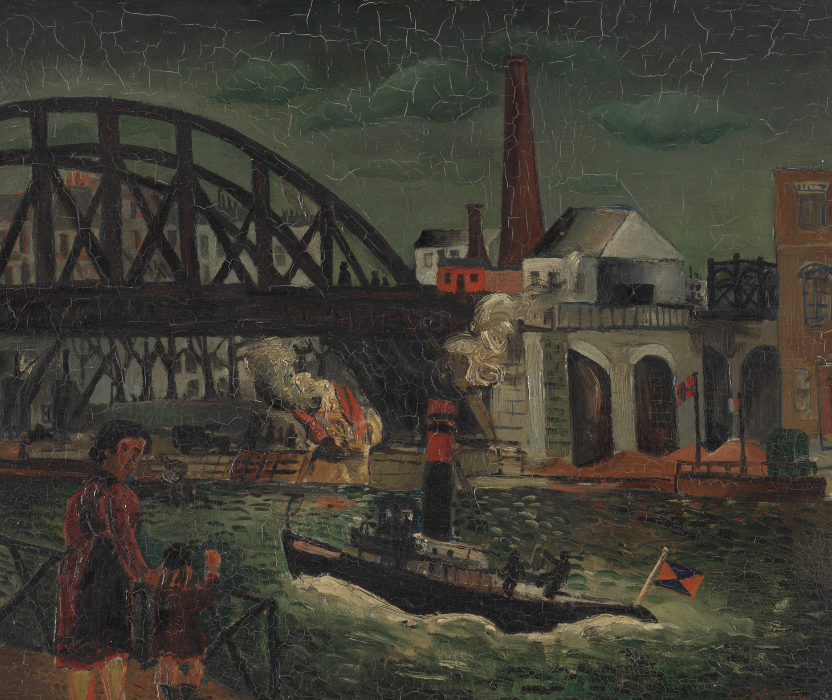
The importance of Paris to Wood’s development is also evident in his artwork titled Bridge over the Seine 1927 in the National Galleries of Scotland collection. The painting depicts a Parisian bridge and the river Seine with buildings and factory chimneys set in the background, while a mother and child are overlooking the scene. The work emphasises the ordinary activities of Parisians rather than an idealised view of the city and demonstrates Wood’s recurring fascination with figures, architecture, and daily life, as elements within a highly personal visual language.
Wood’s life and career came to an abrupt ending when he died in 1930 at twenty-nine, after a period of increasing psychological instability and opium addiction. His reputation nevertheless grew rapidly after his death. The Redfern Gallery in London held a Christopher Wood exhibition in 1936 and later organised a major retrospective in 1938, in which the artwork Paris was exhibited, which helped establish his position within the history of British modern art.
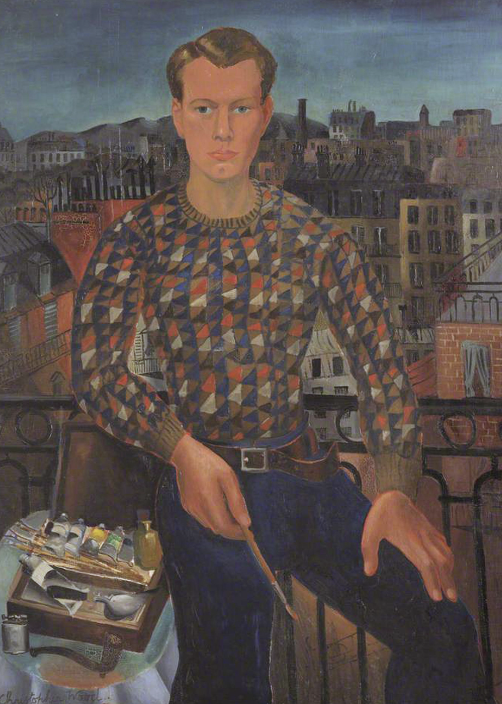
The body of work that Chrisopher Wood produced in his fleeting career demonstrates why his work continues to fascinate contemporary audiences. His paintings are modern without being doctrinaire and sophisticated without sacrificing spontaneity. In his depictions of Paris, the cityscape, architecture, trees, and people are transformed into a vivid arrangement of colour and line. Paris becomes not simply a place Wood observed, but a place he reinvented, a city of memory, sensation, and imagination.
1. The Redfern Gallery, Christopher Wood, accessed on 23 August 2026: https://www.redfern-gallery.com/artists/76-christopher-wood/overview
2. Ibid.
3. Tate Britian, Christopher Wood, accessed on 23 August 2026: https://www.tate.org.uk/art/artists/christopher-wood-2167
4. The Redfern Gallery, Christopher Wood, accessed on 23 August 2026: https://www.redfern-gallery.com/artists/76-christopher-wood/overview
5. Ibid.
By Amanda Hayward, Senior Art Specialist
Top Image Detail: Christopher Wood (British, 1901-1930) Paris, oil on board, 37.5 x 45.5cm. $80,000 – 120,000
October 2026