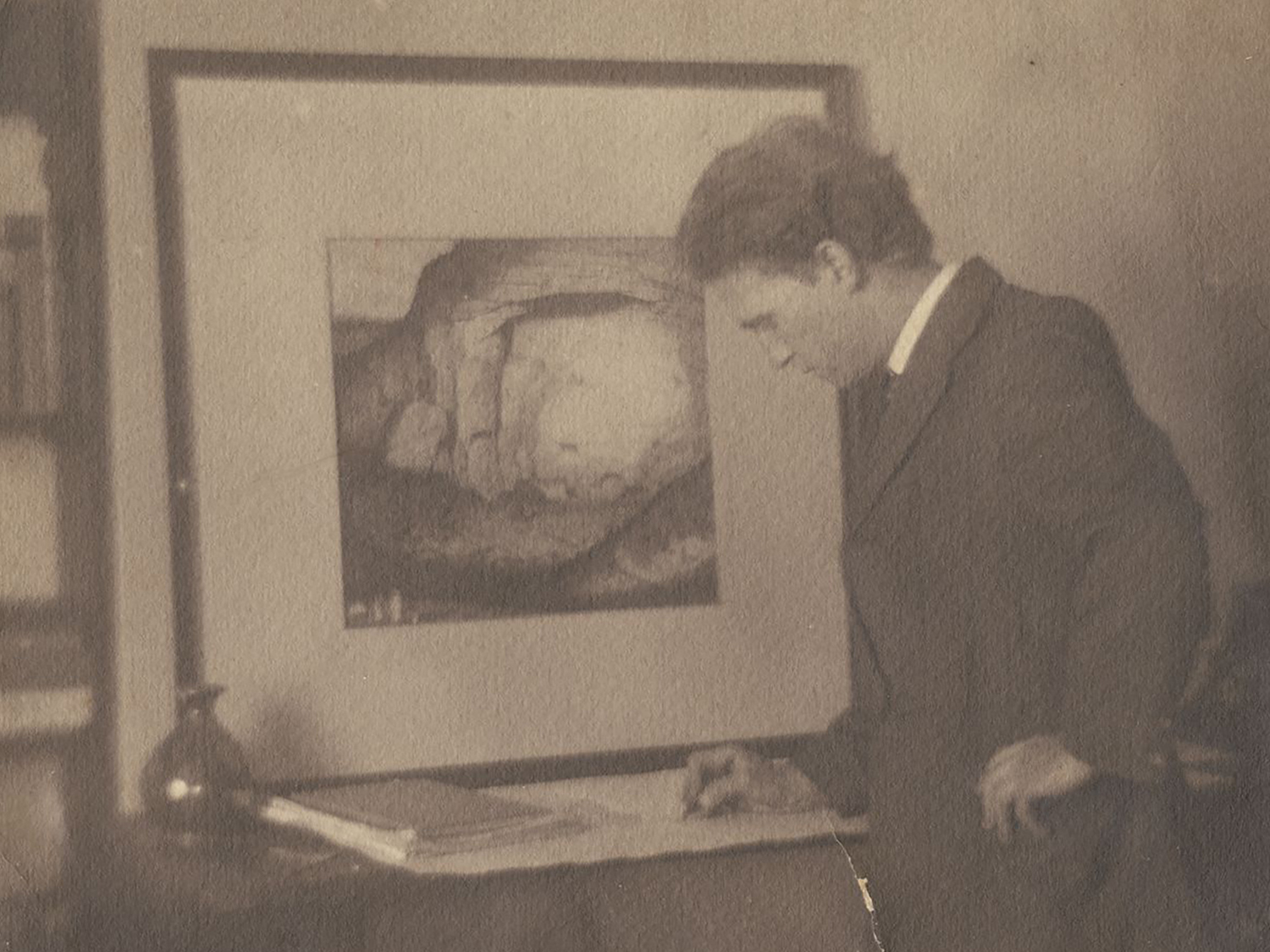
The history of Australian landscape painting is, in many ways, a story about light. From early colonial artists struggling to interpret an unfamiliar environment to modern painters who embraced its unique qualities, generations of artists have sought to understand how the Australian sun transformed the land. Among them, Lloyd Rees stands out as one artist who had a profound impact on the way Australians saw their landscape, revealing not just its physical form but its atmosphere, luminosity, and sense of place.
Early colonial painters often viewed Australia through European eyes. They attempted to impose European artistic conventions onto a landscape that appeared strange and unknown. By the late nineteenth century, however, painters of the Heidelberg School, including Arthur Streeton and Tom Roberts, began painting en plein air and embracing the teachings of European Impressionism combining them with the brilliance of the Australian sun.
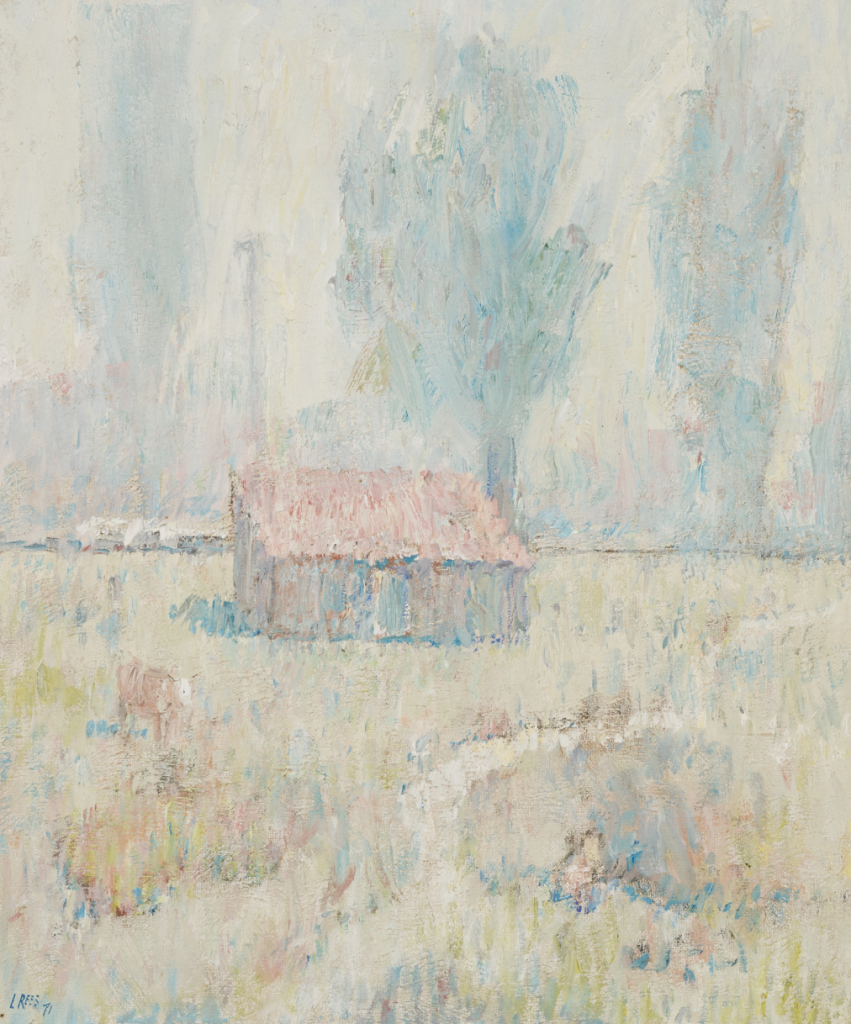
PROVENANCE: The artist, Gift from the above to Michel Santry. The Estate of Michel Santry Menzies, Sydney, Australian & International Fine Art & Sculpture, 10 December 2015, lot 20 (label verso) Private collection, Sydney. $20,000-30,000
The twentieth century brought new approaches to depicting the unique Southern Hemisphere sun. Artists associated with Australian Tonalism, led by Max Meldrum, focused on tonal relationships rather than colour. Meldrum taught his students to observe carefully and objectively, arguing that precise tonal renderings alone would produce the sensation of the picture plane and create a unified sensation of light, atmosphere, space and distance.1 His ideas profoundly influenced a generation of Australian modernists, including Lloyd Rees.
Born in Brisbane in 1895, Rees studied art before moving to Sydney in 1917. A visit to Europe in 1923 and 1924 exposed him to the works of artists such as Camille Corot and J. M. W. Turner, whose approaches to landscape left a lasting impression. Yet rather than simply adopting European methods, Rees returned determined to discover what made Australian light different. He recognised that the Australian landscape was defined not by dramatic shadows and theatrical contrasts, but by a broad, open illumination.
Along with Rees’ exceptional draftsmanship, this sensitivity to light and landscape became a hallmark of his artistic career which spanned over seven decades. His early works demonstrated extraordinary precision and skill, but over time he became less interested in exact description and more focused on capturing the experience of seeing. As he wrote later in his career: All my early thinking on the matter has been that you can paint reflective light but not the source of it. In a realistic sense that is true but when I think round it, painting is not reality – painting is symbolism. 2
While Lloyd Rees is most often associated with his celebrated depictions of Sydney Harbour and its foreshore suburbs, he also maintained a deep personal connection to the Bathurst district of New South Wales. Through his wife Marjory Pollard’s family connections, he visited the region regularly from the 1930s onwards and developed a deep affection for its wide-open spaces. He recalled the stillness of winter mornings at Mt Rankin, the warmth of family homes and the expansive views stretching towards the Macquarie Plains. These experiences became a rich source of artistic inspiration. 3
A notable example is Morning at Bathurst (1971), a work that sits comfortably within Rees’s mature oeuvre. By this stage of his career, Rees had moved beyond the precise analytical approach of his early years towards the luminous “visions of light” that characterised his later work.
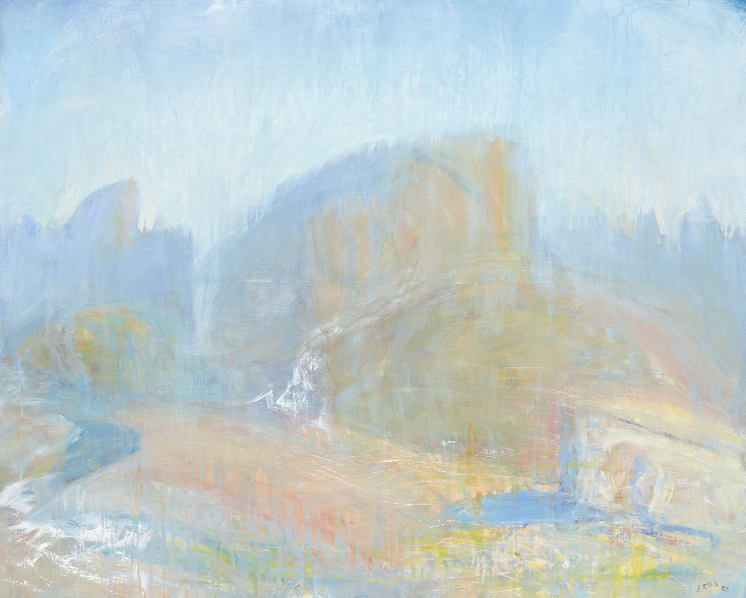
From the late 1960s when his son settled in Hobart, Rees was also inspired by the Tasmanian landscape and it features heavily particularly throughout his later work. He lived his final years in Tasmania, continuing to paint despite failing eyesight. Here he produced larger canvases that revealed an increasingly ebullient and experimental approach. In 1982, he won the Wynne Prize for a second time for his sizable canvas Morning on the Derwent (1982).4
Rees’s influence on Australian art was immense. His work inspired younger artists including John Olsen and Brett Whiteley, the latter dedicating a painting in his honour. By focusing on the unique qualities of Australian light, he helped redefine how the nation saw its landscape. As critic David Cox wrote in reviewing Rees’s 1969 retrospective, “The story of this man’s working life begins in light” and would ultimately “end in light”.5 It is a fitting assessment of an artist whose enduring legacy lies in revealing the luminous beauty of Australia itself.
1. Art Gallery of South Australia. “Introducing Max Meldrum.” Accessed August 26, 2026.
https://www.agsa.sa.gov.au/education/resources-educators/resources-educators-austra lian-art/clarice-beckett-present-moment/introducing-max-meldrum/
2. Holmes à Court Gallery. “Lloyd Rees: Looking for Light.” Accessed August 26, 2026.
https://www.holmesacourtgallery.com.au/exhibition/lloyd-rees-looking-for-light/
3. Bathurst Regional Art Gallery. “Exhibition Focus: Lloyd Rees.” Accessed August 26, 2026.
https://bathurstart.com.au/permanent-collection/exhibition-focus-lloyd-rees/
4. Art Gallery of New South Wales. “Lloyd Rees.” Accessed August 26, 2026.
https://www.artgallery.nsw.gov.au/collection/artists/rees-lloyd/
5. Holmes à Court Gallery. “Lloyd Rees: Looking for Light.” Accessed August 26, 2026. https://www.holmesacourtgallery.com.au/exhibition/lloyd-rees-looking-for-light/
By Madeleine MacKenzie, Head of Decorative Arts & Art, Sydney
Top Image: Lloyd Rees sketching, 1920 / The University of Queensland Library
October 2026