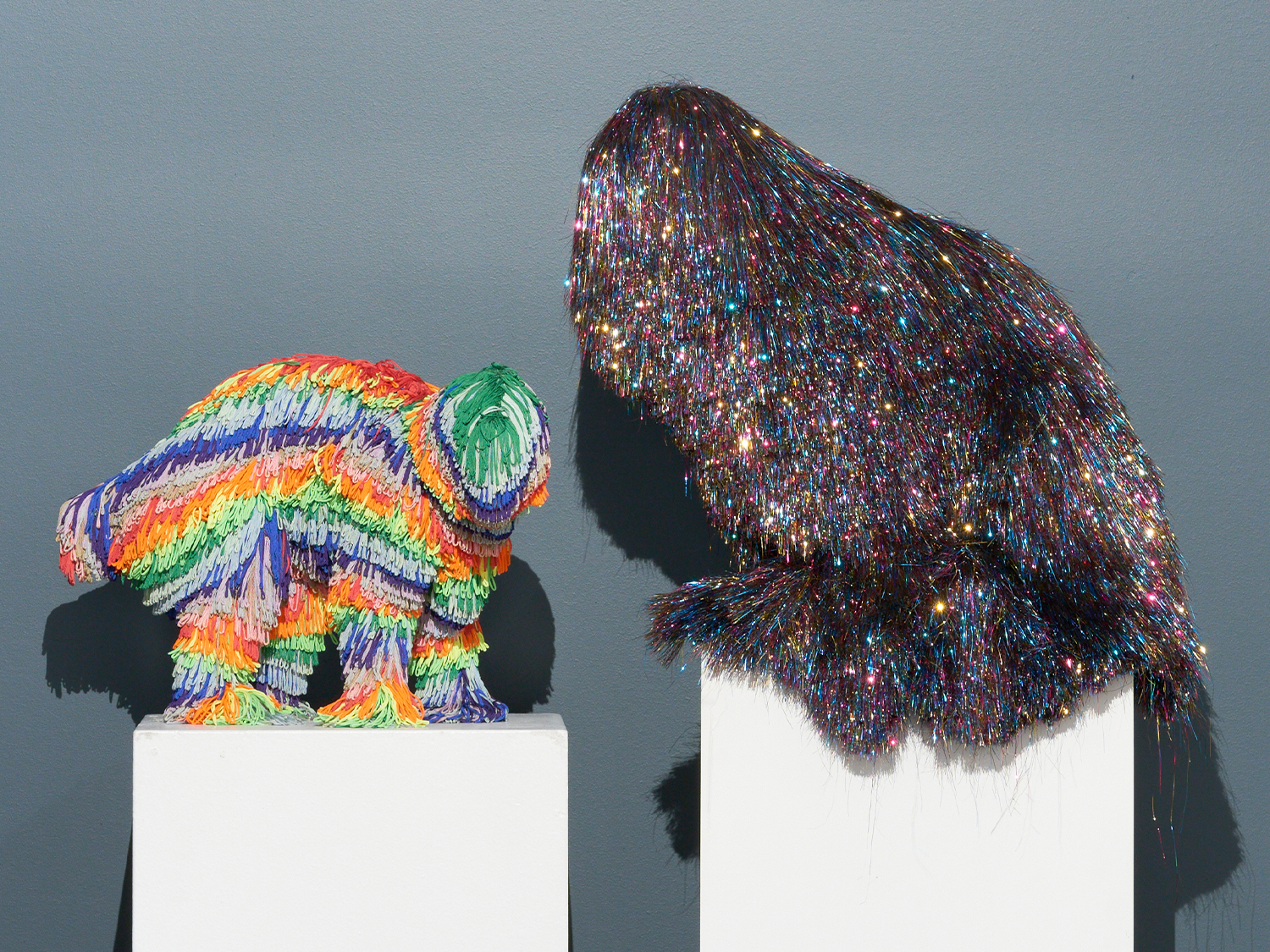
In the vibrant world of contemporary Australian art, few practices feel as tactile, whimsical, and conceptually layered as that of Melbourne based artist Troy Emery. Emery uses decorative materials to explore ideas of craft, spectacle, and the construction of nature within contemporary culture, blurring the traditions of high art and craft.
Emery creates sculptures that summon the familiar by constructing animal forms that recall beloved pets, soft toys, or decorative motifs from cultural artifacts. His sculptures are often described as faux taxidermy, as instead of real fur or feathers, he covers polyurethane and textile bases with layers of pom-poms, tassels, yarn, and tinsel, creating forms that sit somewhere between creaturely bodies and ornamented objects. There is a seductive allure to these surfaces he presents. The tinsel glints like imaginary fur against the light and the fabrics are layered like dense pelts, appearing simultaneously peculiar and mesmerically tactile. By taking mass-produced materials traditionally defined as craft and deploying them into sculptural forms (sometimes monumental in scale), Emery compels viewers to confront questions about aesthetics, value, and the boundaries of artistic practice.
Emery’s studio life and the intimate world he brings to his artworks is shaped by the companionship with his two cats, BaoBao and Stella who are inspirations for the affectionate creatures and curiosities that occupy his oeuvre. The thoughtfully constructed textile animal forms, featuring playful curled tails, readied stances, and slight titled heads, reflect Emery’s deep understanding of animals and celebrate the complex bond between humans and animals.
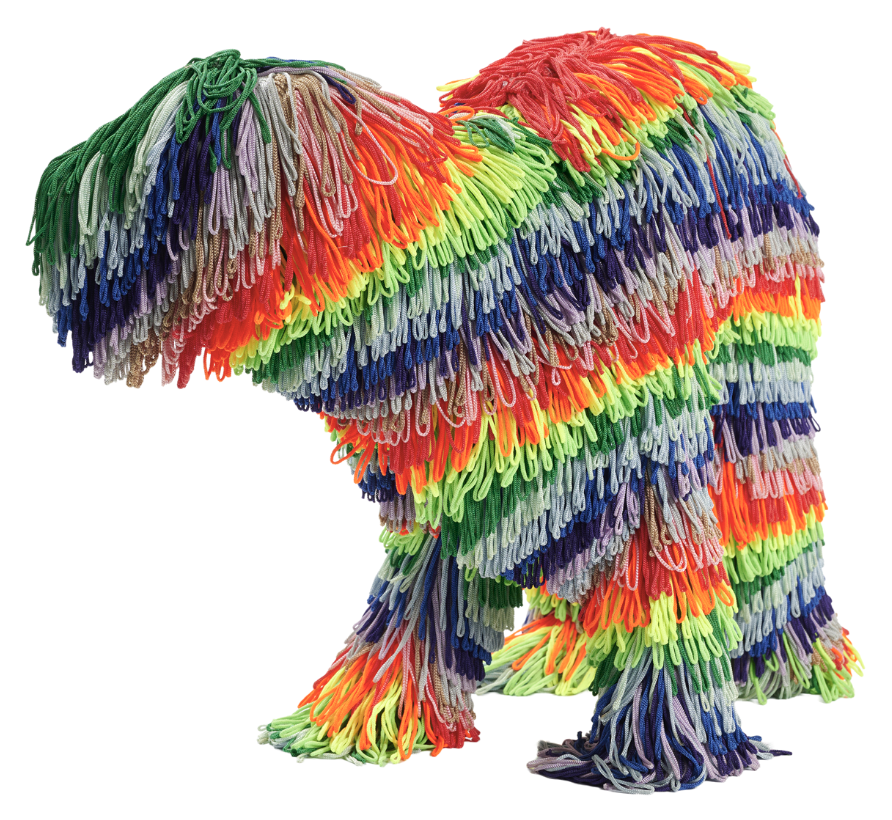
Two prime examples of Emery’s sculptural works include Black Opal 2019 and Wild Thing X 2011 in our upcoming contemporary art auction, Centum. In Black Opal, the polyurethane body is covered in shimmering tinsel creating a luminous and alluring surface. The iridescent strands change colour in the light, evoking the geological phenomenon of a black opal, while also referencing craft and costume. The animal’s form is partially obscured beneath the glittering layers of tinsel, denying the viewer a clear anatomical reading and this ambiguity destabilises the distinction between creature and object.
In contrast, Wild Thing X presents a more legible animal structure, built over a polyurethane mannequin and covered in cascading tassel fringing. The layered strands create a rhythmic, almost painterly effect of stripes and coloured bands, recalling fashion and theatrical costumes. Unlike the glittering surface of Black Opal, the tassels in Wild Thing X emphasise repetition and pattern, transforming the animal into a walking abstraction and this is further emphasised by the animal’s dynamic stance.
Emery’s artworks subvert traditional expectations of sculptures being solid and fixed. The surfaces appear soft and sensorial, inviting touch while simultaneously resisting reality. By using materials associated with decoration and performance, Emery challenges traditional hierarchies between fine art and craft, and between the natural and fabricated world. These sculptures operate in a liminal space; they are part animal, part costume, and part commodity, reflecting how contemporary culture constructs and consumes images of the natural world.
Troy Emery’s sculptures challenge the legacy of natural history museums, institutions that have historically framed animals as trophies or specimens, inert and frozen in time. By replacing fur and pelts with mass-produced and artificial craft materials in vibrant colours, he upends the familiar taxonomy of animal representation in natural history museum spaces and places them into the fine art object realm. The results are sculptures that are decorative, uncanny, and profoundly reflective, blurring the boundaries between fine art, museums, natural history, and craft.
By Amanda Hayward (née North), Senior fine Art Specialist
Top Image Left to Right: Troy Emery (born 1981) Wild Thing X 2011, polyurethane mannequin, tassel fringing and glue, 34 x 52 x 23cm, $2,000-4,000. © Troy Emery/Copyright Agency, 2026
Troy Emery (born 1981) Black Opal 2019, polyurethane, tinsel, adhesive, pins, 50 x 60 x 37cm, $4,000-6,000. © Troy Emery/Copyright Agency, 2026
March 2026