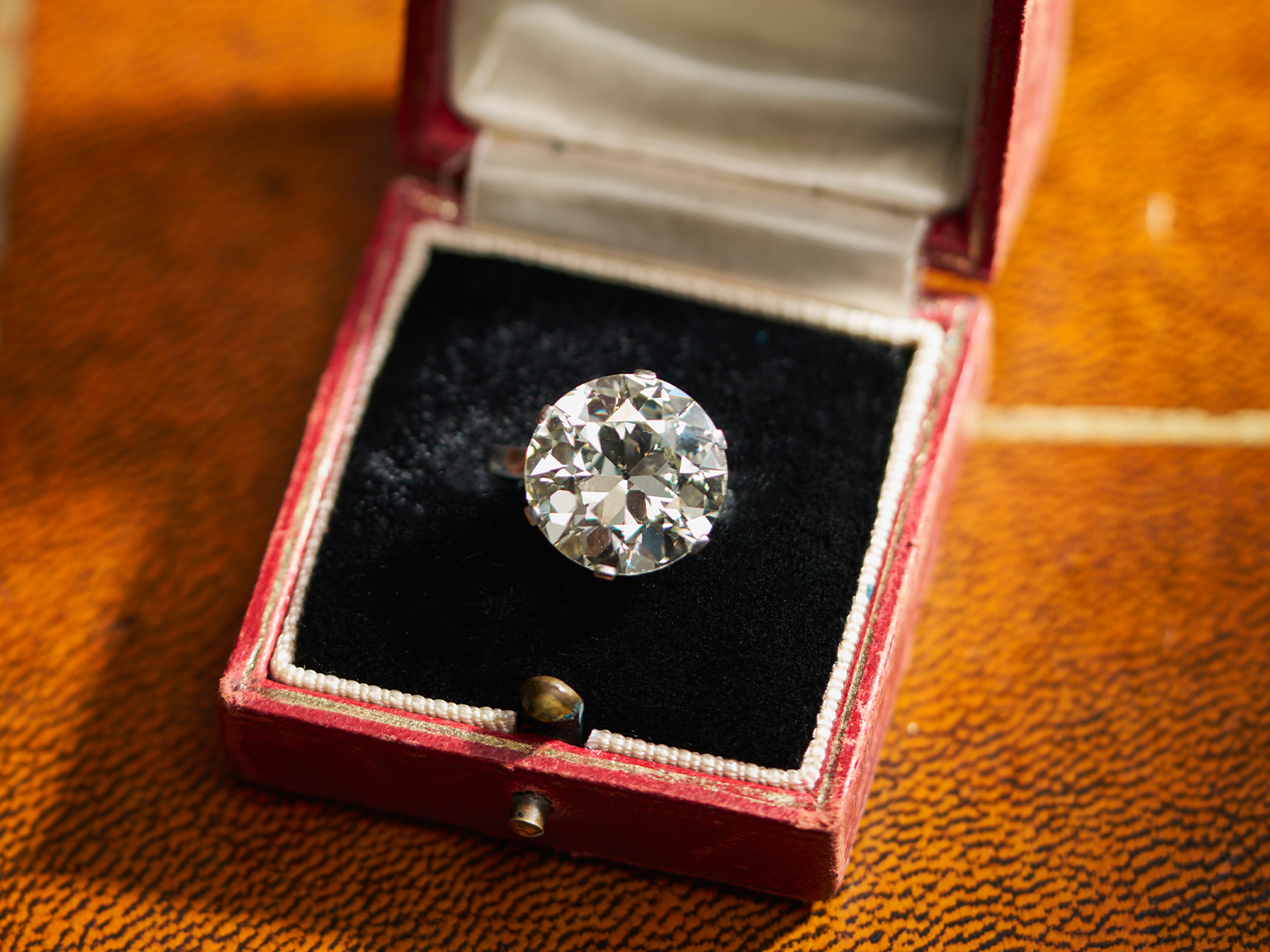
The resurgence of antique diamonds has found an unlikely modern ambassador in Taylor Swift. Her engagement ring, with its elongated antique-style diamond, has drawn fresh attention to the beauty of old-cut stones and the qualities that set them apart from their modern counterparts. Rather than the precise symmetry and engineered brilliance we have come to expect, antique diamonds have softer proportions, larger facets and an individuality that comes from being cut by hand. In a world where technology can now calculate and control almost every facet of a diamond, there is something rather wonderful about a stone whose character was shaped by the eye and hand of a cutter generations ago.
From the soft glow of the Rose Cut to the chunky charm of the Old Mine Cut and the distinctive brilliance of the Old European Cut, the evolution of antique diamond cutting offers a fascinating window into the history of jewellery. Each development brought a new approach to working with this extraordinarily hard and precious material, while reflecting the changing tastes of the people who wore it.
14th–17th Century
The story of diamond cutting begins in medieval Europe in the 14th century with the Point Cut. Limited by the technology of the time and diamond’s exceptional hardness, early cutters worked with the stone’s natural octahedral form, simply polishing its eight faces to enhance its surface and allow it to catch the light.
During the Renaissance, the Table Cut emerged as an important development. By grinding down one of the diamond’s points, cutters created a flat surface, or “table”, providing a window into the stone and beginning the transition towards more sophisticated faceting.
The next major innovation was the Rose Cut, named for its resemblance to a rosebud. With a flat base and a domed upper surface of triangular facets arranged in rows and meeting at a central point, it produced a soft, subtle play of light. Believed to have originated in India in the late 15th century, the rose cut was refined in the diamond-cutting workshops of Antwerp and Amsterdam and became highly fashionable throughout the 16th and 17th centuries.
Because of its flat base, the rose cut could appear relatively subdued by today’s standards. To enhance its luminosity, diamonds were sometimes foiled, with reflective or coloured foil placed behind the stone. Under candlelight, this gave rose-cut diamonds a warm, atmospheric glow perfectly suited to the jewellery of the period.
18th–19th Century
At the beginning of the 18th century, diamond cutting took another significant step forward with the development of the Old Mine Cut. These early stones were typically square or cushion-shaped with softly rounded corners. Cut by hand, they were designed to retain as much of the valuable rough diamond as possible, resulting in a high crown, deep pavilion and often a noticeably large culet.
Unlike the symmetry we expect from diamonds today, Old Mine Cuts were individual and often slightly irregular, with smaller tables, larger facets and proportions that varied from stone to stone. Rather than the sharp brilliance of a modern diamond, they produced a softer, warmer play of light, particularly beautiful under candlelight.
By the late 19th century, diamond cutting had reached another important turning point with the emergence of the Old European Cut. While still unmistakably antique, it represented a move towards greater precision and symmetry and would ultimately provide the foundation for the modern round brilliant.
Typically round in outline, old European cut diamonds featured a high crown, small table, deep pavilion and distinctive culet. They were still fashioned by hand, meaning no two stones were exactly alike, but cutters were becoming increasingly focused on proportion, symmetry and the way light travelled through the stone.
Advances in cutting technology, including improved bruting and polishing techniques, allowed cutters to achieve greater accuracy. At the same time, the introduction of electric lighting changed the way diamonds were viewed, creating new expectations for brilliance and sparkle. The old European cut was the final link between the romantic individuality of antique diamonds and the precision that would define the modern brilliant.
Perhaps that is why antique diamonds continue to capture our imagination. Their appeal lies not in perfection, but in individuality, each stone carrying the marks of its time, its maker and the person who first chose it. And if Taylor Swift’s ring is anything to go by, sometimes looking backwards is the most fashionable way forward.
By Lauren Boustridge, Head of Fine Jewels & Timepieces, Sydney
Top Image: 9.29ct old European-cut diamond solitaire ring, France. $70,000 – $80,000
October 2026