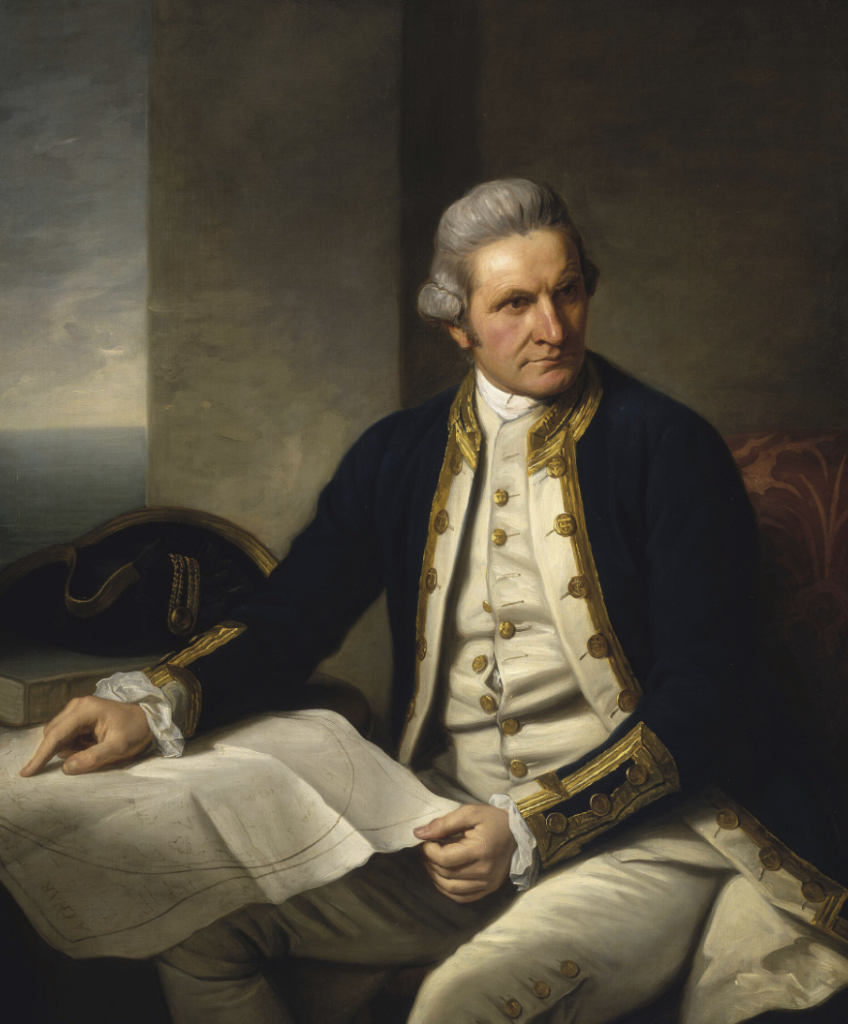
At the time of his violent death in 1779 on a beach in Hawaii, Captain James Cook was one of the most famous and respected of Englishmen. Between 1768 and his end, Cook commanded three lengthy voyages of discovery to different parts of the Pacific and south Atlantic oceans, all serving a variety of scientific and British territorial purposes (including, in 1770, his landing at Botany Bay and careful scientific surveys and charting of Australia’s east coast, claiming this for the British Crown). Aided by Cook’s exceptional abilities as a navigator and leader of men generally, these voyages, each with entourages of scientists in various fields, their assistants, artists, and naval personnel capable of assisting their work, were immensely successful in what they yielded, advancing knowledge in a wide range of areas. In a period in which the intellectual curiosity of the Enlightenment ran hand-in-hand with Britain’s growing territorial expansion, Cook’s accounts of his voyages and exotic discoveries made by these, published with illustrations after drawings by the artists who accompanied him, were keenly read by the elite and intellectually curious in Britain, Europe, and North America.
These same classes and many others beyond were then shocked by news of Cook’s death, which reached the Admiralty in London on 10 January, 1780, nearly a year after the event, and was published the following day in the London Gazette. King George III, reportedly moved to tears by the news, immediately granted Cook’s widow Elizabeth a substantial pension for life. Tributes and letters of condolence poured from the great and good across Britain and Europe. The Royal Society, which had sponsored Cook’s first Pacific voyage and was now headed by Joseph Banks who had been on that voyage, commissioned a commemorative medal to be struck in gold, silver, and bronze. At a more popular level, Cook’s life and death – generally depicted as heroic – was remembered in songs, plays, prints, and commemorative ceramics, including a fine relief portrait modelled by John Flaxman for Wedgwood.
Throughout all of this Cook’s devoted widow Elizabeth was quietly retiring. But in 1785, wishing to have an honour for her husband to be perpetuated by his family, she applied for a grant of arms prompted by ‘her Anxiety to preserve on record in the College of Arms the Memory of her late dear Husband, the ablest and most renowned Navigator which this or any other Country has produced’ (as it is recorded on the subsequent grant of arms). It is a mark of George III’s regard for Cook that he approved this exceptional grant – apparently, the only posthumous grant of arms ever made by the College of Arms.
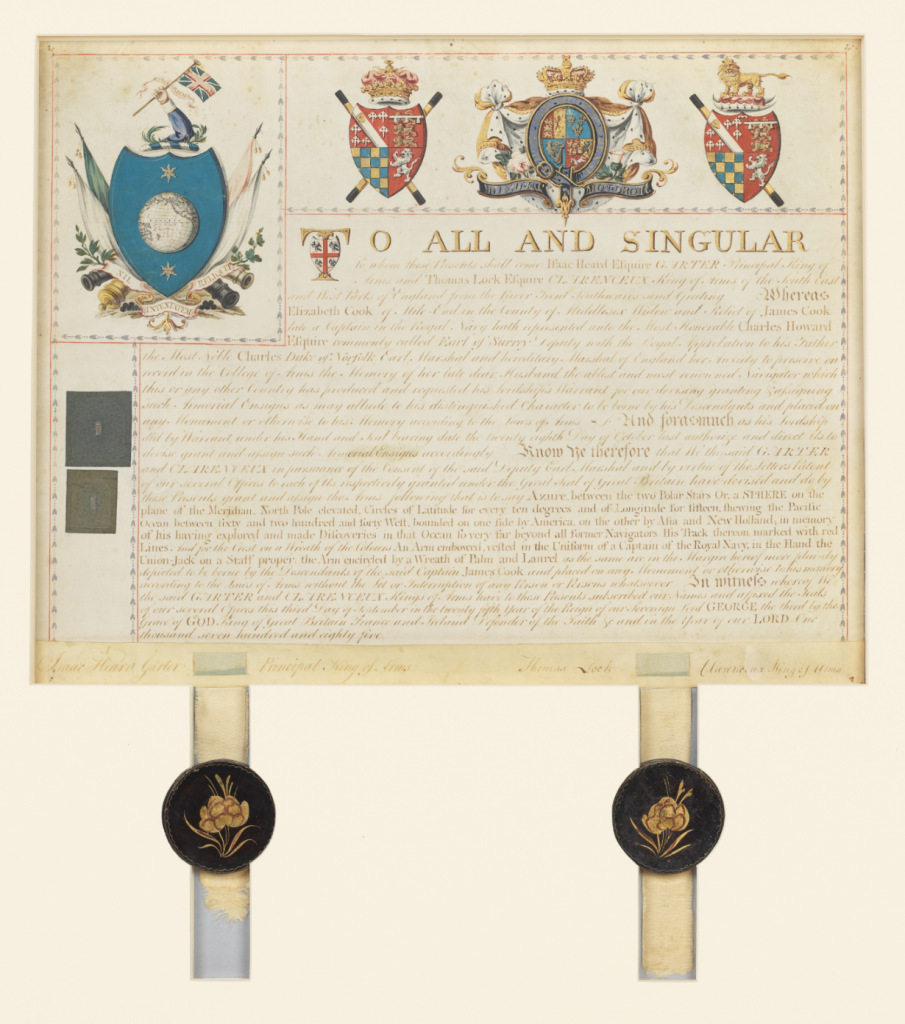
In seeking the grant, Elizabeth requested ‘such Armorial Ensigns as may allude to [Cook’s] distinguished Character to be borne by his Descendants and placed on any Monument or otherwise to his Memory’. The blazons (formal descriptions) of Cook’s armorial bearings specify his crest to be ‘an Arm embowed, vested in the Uniform of a Captain of the Royal Navy, in the Hand the Union Jack on a staff’. The Letters Patent granting the arms on 3 September, 1785 (now in the State Library of NSW) includes a rendering of the bearings with two apt mottos, ‘Circa orbem’ (‘Round the world’) for the crest and ‘Nil intentatum reliquit (‘He left nothing unattempted’) for the coat of arms.
Sadly for Elizabeth, there was little opportunity for her family to use the bearings as she hoped, with all six of the Cooks’ children dying prematurely, the last in 1794, leaving no other descendants. Consequently, very few objects closely associated with the Cooks and bearing his arms are known. A silver salver in the National Library of Australia, assayed in 1764 and believed to have been used by the Cooks together in their household, was later engraved with his full coat of arms shortly after these were granted. A pair of silver candlesticks in the National Maritime Museum, London, assayed in 1784 and acquired by Elizabeth, is engraved with Cook’s crest and motto ‘Circa orbem’. Cook’s bearings were also used for a bookplate commissioned by Elizabeth and applied by her to the Bible which accompanied him on his three great voyages, now in the Mitchell Library, Sydney.
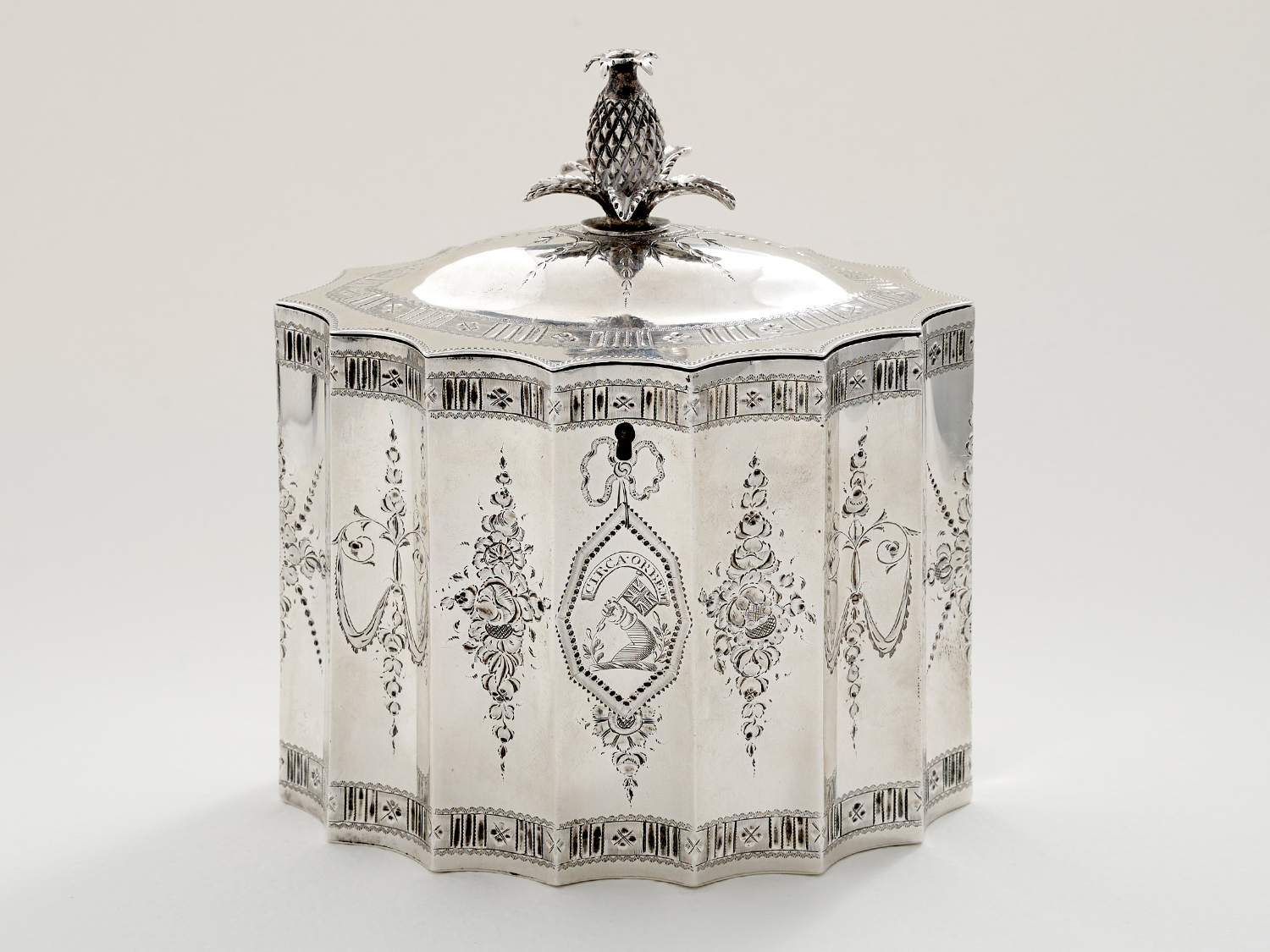
Now, Leonard Joel is honoured to offer another fine object to be added to this extremely rare group: a silver tea canister by Thomas Daniell, assayed in London in 1786 and engraved with James Cook’s crest and motto ‘Circa orbem’, presumably acquired by Elizabeth at this time and, like the salver and candlesticks, promptly and proudly engraved with the then newly-granted crest in honour of her much-loved husband.
By David Parsons, Head of Private Estates & Valuations, Decorative Arts Specialist
Top Image: Elizabeth Cook’s sterling silver tea canister, engraved with the crest of her husband, Captain James Cook, Thomas Daniell, London, 1786. $20,000-30,000
October 2026