Before television broadcasts brought every stride into sharp focus, there was only one reliable way to tell one horse from another during a race: the colours.
Today, they are universally recognised as racing silks or racing colours, featuring combinations of stars, stripes, hoops, and checks flashing across the turf. Some may rely on the colours alone to pick a favourite, yet these seemingly decorative garments are among the oldest surviving traditions in horse racing.
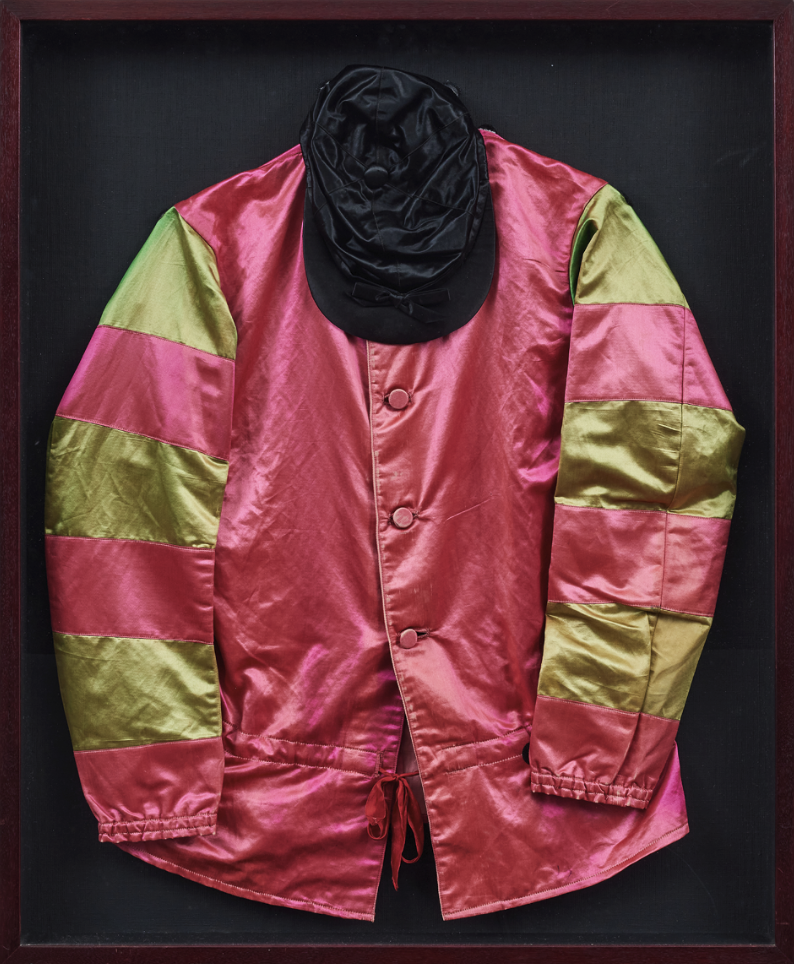
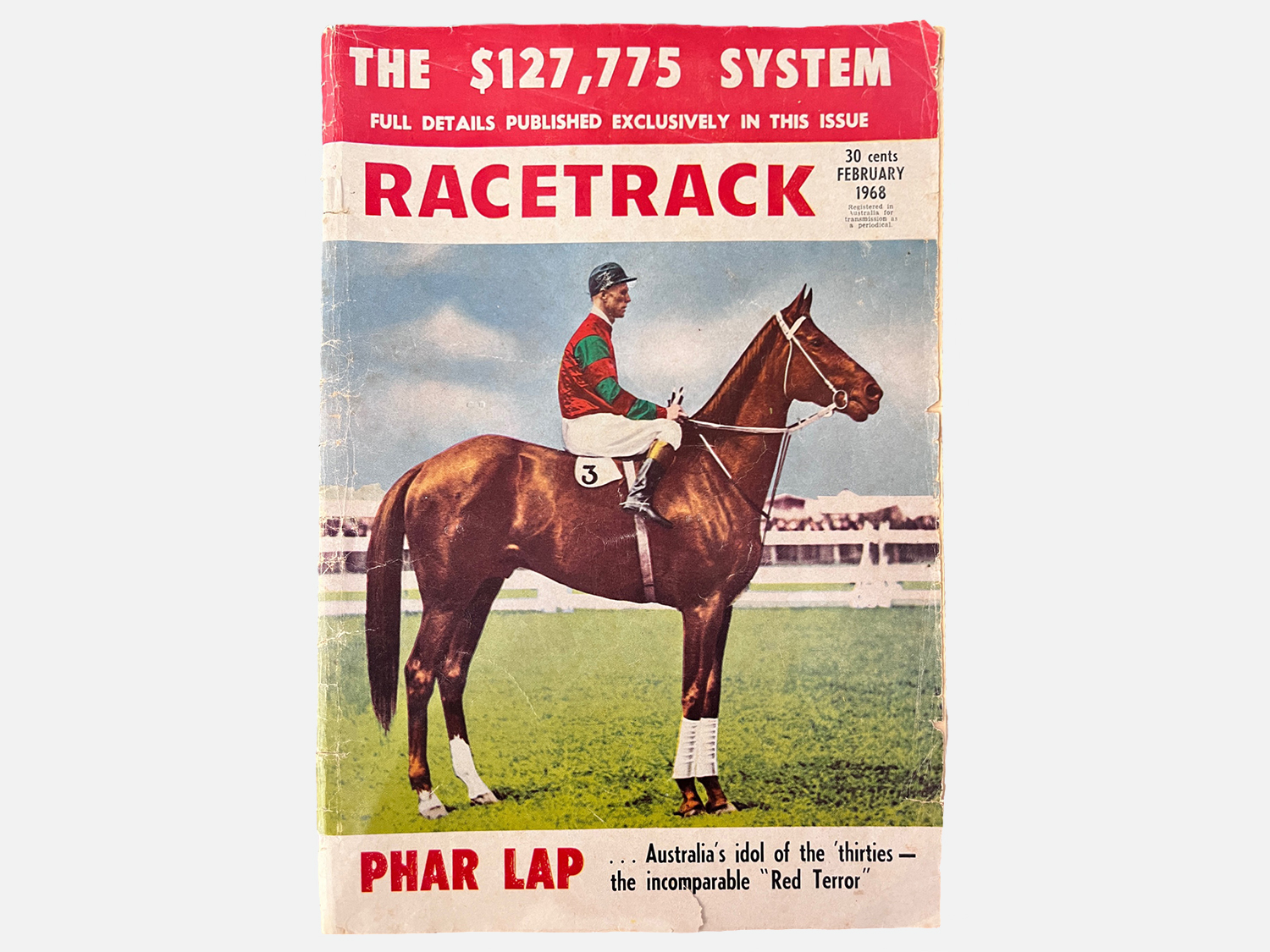
A set of owner’s racing silks comprising a red silk jacket with red and green hooped sleeves, buttonfront fastening, together with a black racing cap, representing the registered colours worn by jockey Jim Pike aboard Phar Lap during the 1931 racing season.
PROVENANCE: Jim Pike (1892 − 1969), jockey for Phar Lap1929-1931. Thence by descent. $20,000-30,000
Despite the name, most modern “silks” are no longer made from silk at all. Lightweight synthetic fabrics have long since replaced the luxurious textile, but the original name has endured as a reminder of racing’s aristocratic beginnings when silk was the fabric of royalty and privilege.
The concept of using colour to distinguish oneself during a race stretches back to as early as the chariot drivers of Ancient Rome, whose coloured capes and headbands helped spectators distinguish competitors hurtling around the Circus Maximus. Others have noted similarities to medieval heraldry, when knights displayed family colours on shields and banners during tournaments. Whatever their precise origin, one thing is certain, visibility mattered.
As organised horse racing flourished in England during the eighteenth century, so too did the crowds. At Newmarket, where races were often run across vast stretches of countryside, distinguishing one horse from another became increasingly difficult. In 1762, The Jockey Club introduced one of racing’s most enduring rules: owners were required to register unique colours so that every horse could be recognised at a glance. It remains one of the world’s earliest examples of a formal sporting registration system.
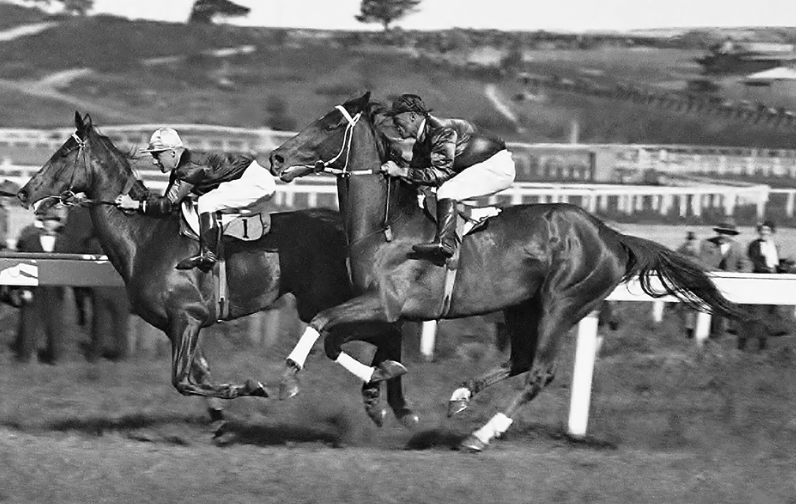
Some of those original registrations are still in use today. For example, The Duke of Devonshire’s distinctive “straw” colours, first recorded in 1762, are believed to be the oldest continuously used racing colours in the world, a remarkable thread connecting modern race meetings with Georgian England.
When horse racing arrived in Australia, the tradition travelled with it. Early colonial race meetings listed not only each horse but also the rider’s “dress”, allowing spectators to follow the action. By the time the Melbourne Cup was established in 1861, racing colours had become an essential part of the spectacle, although duplication remained common until the Victoria Racing Club required owners to officially register their colours in 1867.
Australia has since produced some of the sport’s most iconic combinations. Archer carried jockey John Cutts in the famous all-black colours of Etienne de Mestre to victory in the first two Melbourne Cups. Phar Lap’s familiar red jacket with black and white hooped sleeves became inseparable from the champion himself after he won the Melbourne Cup in 1930 ridden by jockey Jim Pike. These original silks are now housed in the Melbourne Museum, Victoria. However, some may not realise that racing colours are registered to the owner of the horse and when a horse changes ownership the jockey must wear the newly registered colours of the new owner. In 1931 when ownership arrangements changed for Phar Lap, the silk colours also changed to red with red and green hoops on the sleeve and a black cap. This second set of colours, worn by Jim Pike when he rode Phar Lap to multiple victories in 1931, is being sold by Pike’s grandson in our Collector’s Auction in Sydney on the 8th of September.
If one were wishing to create a new set of colours today, they would find that it’s no mean feat. Every design must be unique within its racing jurisdiction, forcing owners to navigate an intricate web of quarters, hoops, chevrons, stars, diamonds, spots, and sleeves. As registrations have multiplied, originality has become increasingly elusive, turning colour selection into something between art, branding, and genealogy.
Perhaps that is why racing colours hold such enduring appeal. They are both practical identifiers and also deeply personal emblems. Passed through generations, instantly recognisable to racing enthusiasts, and immortalised in winners’ photographs, they become visual shorthand for sporting greatness.
Long after the roar of the crowd fades and the trophies are polished and put away, it is often the silks that remain fixed in memory as bright flashes of colour racing across the turf.
By Madeleine Mackenzie, Head of Decorative Arts & Art, Sydney
Top Image: Jim Pike mounted on Phar Lap c.1931 on the cover of Racetrack, February 1968
August 2026