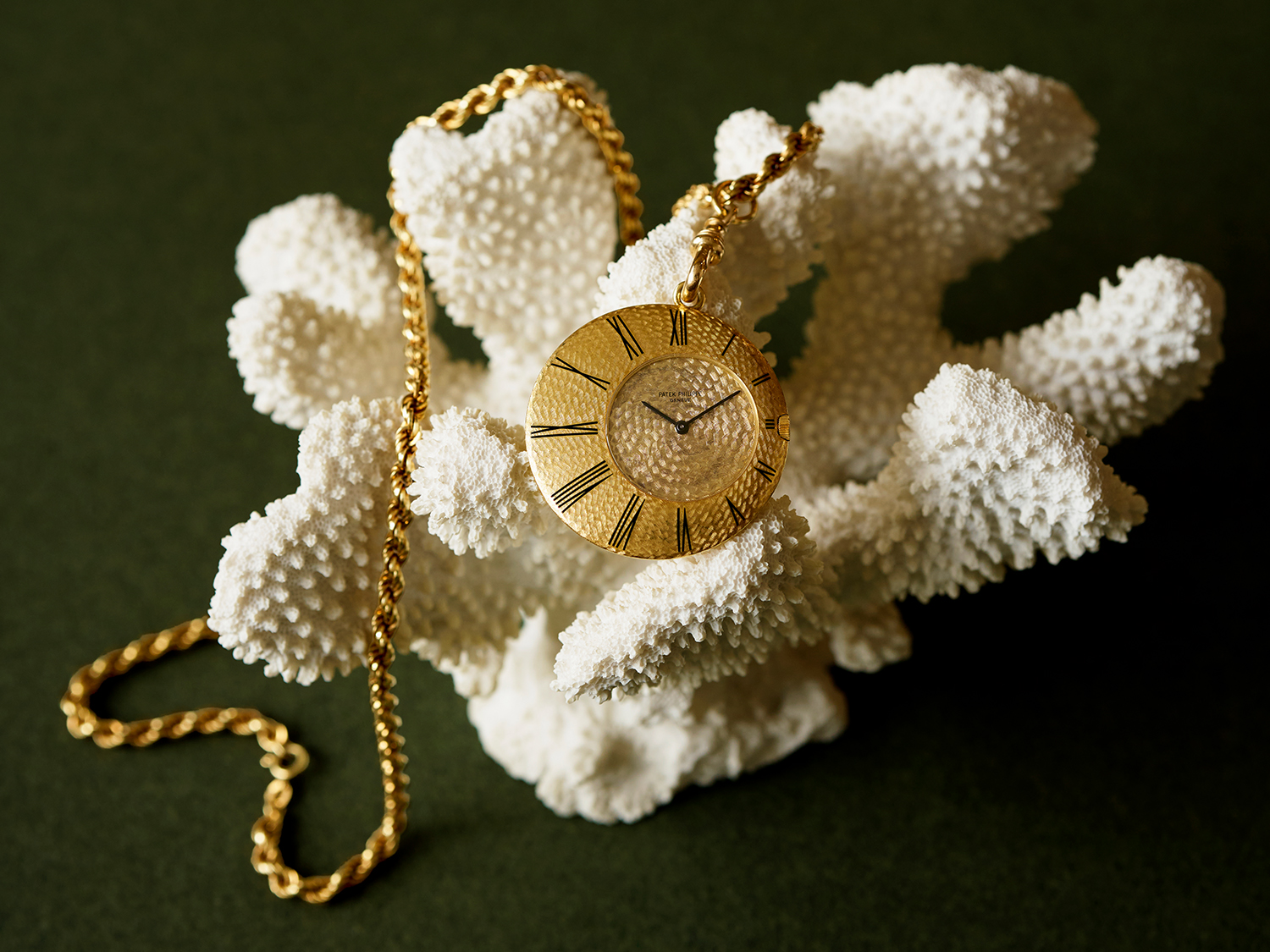
By the mid-20th century, it was becoming increasingly apparent that things were starting to get more and more ‘out there’. A pervasive resistance to conformity and monotony began to emerge across all sectors of society. The watch industry was equally swept up in this cultural rebellion, led by its two primary disruptors, Gérald Genta (1931-2011) and Gilbert Albert (1930-2019) who caused classic watch design to get ‘all shook up’.
Both of these designers tore up the traditional horological rulebook, approaching the watch as a canvas in completely opposing, yet equally revolutionary ways. What resulted were some mind-bending designs so distinct and influential that they permanently altered the (watch)face of horology for time evermore.
While Gérald Genta is understandably worshipped for his Audemars Piguet Royal Oak and the Patek Philippe Nautilus – the design that would give rise to the modern luxury sports watch category, Gibert Albert was equally unconventional but in a more sculpturally organic way.
Born in Geneva in 1930, the son a newspaper delivery man, Gilbert Albert’s artistic journey was shaped by a lifelong fascination with the natural world, a profound connection that would play out in his future designs through organic textures and structures. Albert was enrolled at the prestigious l’Ecole des Arts Industriels in Geneva at the age of 15. There, he would immerse himself in modern sculpture and the revolutionary spatial languages of the pioneering modern artists Constantin Brâncusi and Piet Mondrian. From this study he would come to fuse the rigid, geometric minimalism of Mondrian with the fluid, spatial abstractions of Brâncusi. No doubt the advice of his college mentor; “If you want to succeed, do what others will not do,” was not lost on Albert.
In 1955, at 25 years old and fresh from his training, Albert was hired by Patek Philippe as part of the design team. Henri Stern, who managed the company at the time, was himself a trained jeweller and was quick to identify something unconventional and equally exceptional in Albert. Recognising a shift in the cultural landscape, Stern observed that the burgeoning post-war jet set craved bold innovation over traditional conformity. But nurturing Albert’s radical vision was a calculated gamble. It may have aligned with Stern’s desire to expand Patek Philippe’s jewellery-fused watch capabilities but was the watch world ready for a watch case revolution and particularly from a maison whose ethos was best embodied in the classic restraint of their signature Calatrava?
Albert would let rip at Patek Philippe, introducing wildly asymmetrical case designs that felt more like mid-century sculpture than traditional watchmaking. Pebble shapes, flying wedges, organic forms, lop-sided silhouettes; these cutting-edge timepieces pushed the boundaries of what a wristwatch could look like. Today, we find it difficult to grasp the initial resistance these designs were met with from certain sectors. Basel crowds may have queued to glimpse Albert’s latest creations, but risk-averse retailers routinely balked at their commercial viability. Just as an aside, this is the same market scepticism that in 1977 mirrored the reception of the steel Nautilus, a time when American executives despaired that the manufacturer had ‘lost its mind.’
After his time at Patek Philippe, Albert went on to work for Omega. His collaboration with Omega was even more experimental. The watch curiosities produced during this period are less utilitarian and even more conceptual. His most daring timepiece designs were almost exclusively for women. Elaborate mesh bangle watches such as the Mailles d’Or, Rocaille d’Or and Frisson d’Or became signature pieces, often with the watch dial hidden beneath the intricate design of the bracelet.
Ultimately these rare, avant-garde masterpieces remain a testament to a designer who was perpetually ahead of his time. Alongside but in contrast to Genta, Gilbert Albert remains one of the most imaginative, revolutionary, and awarded watchmaking jewellery designers of his era. Albert’s legacy lives on in his strange, yet strangely compelling, creations that sit closer to modern art than horological equipment.
By Patricia Kontos, Senior Jewels & Timepieces Specialist
Top Image: Perhaps the most famous and recognisable of Gilbert Albert and Patek Philippe’s collaborations is the Ricochet produced from 1962-1968. In this unconventional and avant-garde creation, we recognise how Albert drew inspiration from Brancusi and Mondrian. The asymmetrical geometric form reflects the experimental spirit of the period and stands in sharp contrast to the traditional Calatrava aesthetic.
Patek Philippe Ricochet Ref 789/1 a pendant watch designed by Gilbert Albert, circa 1962. $8,000-12,000
August 2026