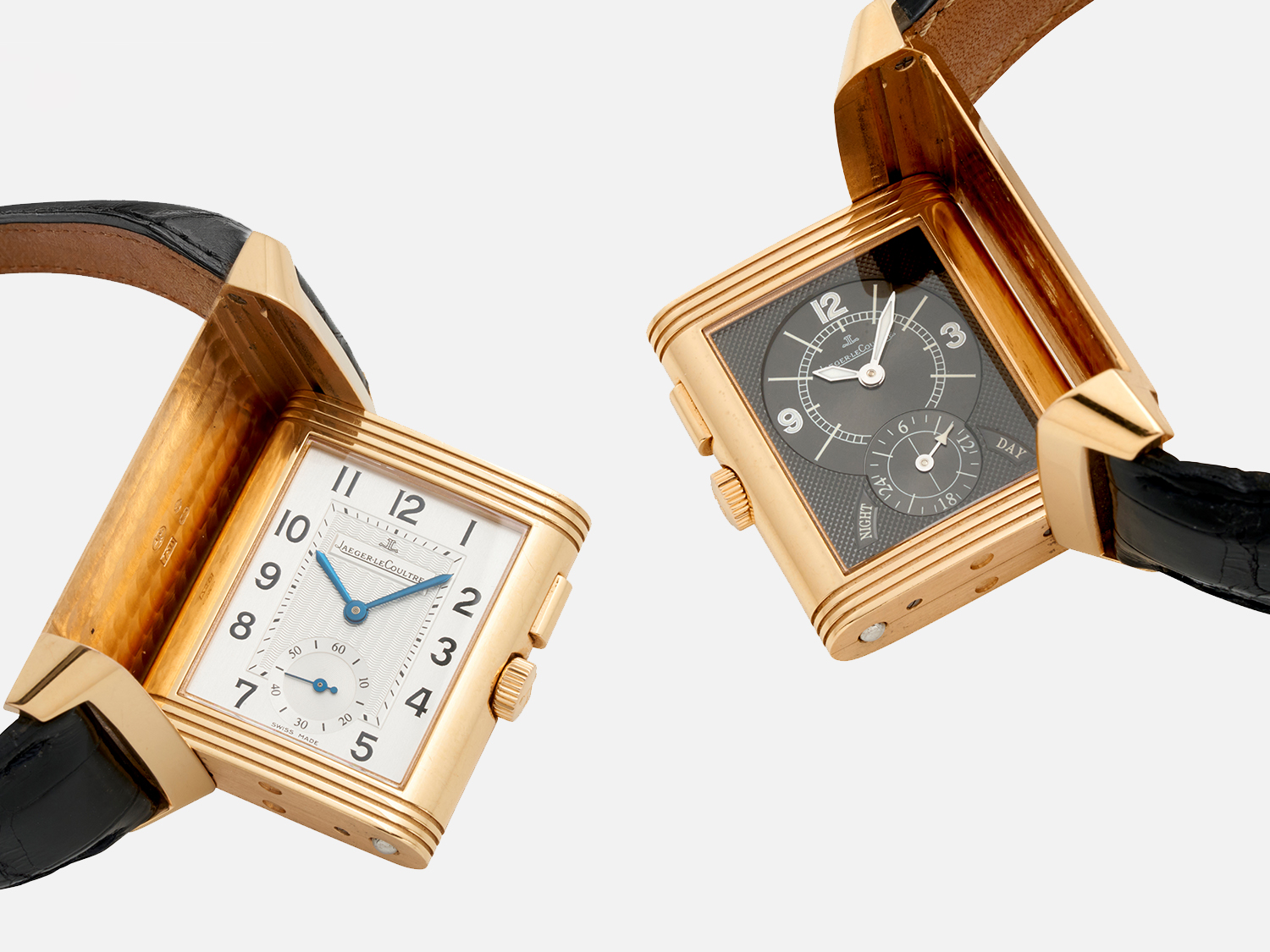
It may surprise you, as it did me, to learn that the 1930s Jaeger-LeCoultre Reverso may not have been the first reversible watch, but such is its iconic status that it owns the reversible watch case space. Not only did the Reverso upset the status quo for being a rectangular watch powered by a rectangular movement at a time when round watches dominated, it went much further in that it was able to completely flip in its housing, and that is how Reverso, from the Latin for ‘I turn around’, emerged from its shell.
The origins of the reversible watch are not so clear-cut. Some accounts suggest that four years before the Reverso’s debut, another Swiss manufacturer had already ventured into this alterable territory. The watchmaker associated today for later icons such as its Compax chronographs and Polerouters, Universal Geneve, possibly introduced their version of a convertible wristwatch in 1927 and patented it in 1933. An Art Deco exemplar of clean geometry and strong lines in a refined rectangular case, the watch was released as the Ideo and later the Cabriolet. But unlike the Reverso’s fluid swivelling mechanism, this precursor was more mechanical, though no less inventive. The watch case sat within a frame secured by a small screw at six o’clock, and once released, the inner container could be lifted, rotated, and snapped playfully back into place.
The creator of Universal Geneve’s Cabriolet case design has slipped into obscurity over time. By contrast, the origins of the Jaeger-LeCoultre Reverso are well documented and owe much to the efforts of César de Trey. An entrepreneurial businessman and associate of Jacques-David LeCoultre, the then owner of the LeCoultre manufacture, de Trey travelled to Colonial India in 1930 where he witnessed the shine with which British army officers had taken to the game of polo.
What today is known as the ‘Sport of Kings’ was originally a rigorous Persian cavalry training exercise, evolving into an aristocratic pastime before being codified by British officers in India during the mid-19th century. It was during the intensity of one such match, that de Trey witnessed the players’ frustration at the shattering sound of watch crystals and damaged dials during play. The story goes that an officer, his watch in pieces, challenged de Trey to come up with a timepiece robust enough to withstand polo’s punishing demands.
Up for the challenge, de Trey conceived the idea of a dial that could be protected by being turned upside down. He then approached LeCoultre with the ingenious concept and from there a French industrial designer, René-Alfred Chavot, was tasked with bringing it to life with a slide and flip mechanism. On March 4, 1931, the Paris patent office received an application to file for “a watch capable of sliding into its housing and turning over completely”.
A man of vision, de Trey promptly acquired the rights from Chavot and registered the name Reverso. Eager to capitalise on its commercial potential, de Trey and LeCoultre signed a partnership and started production immediately.
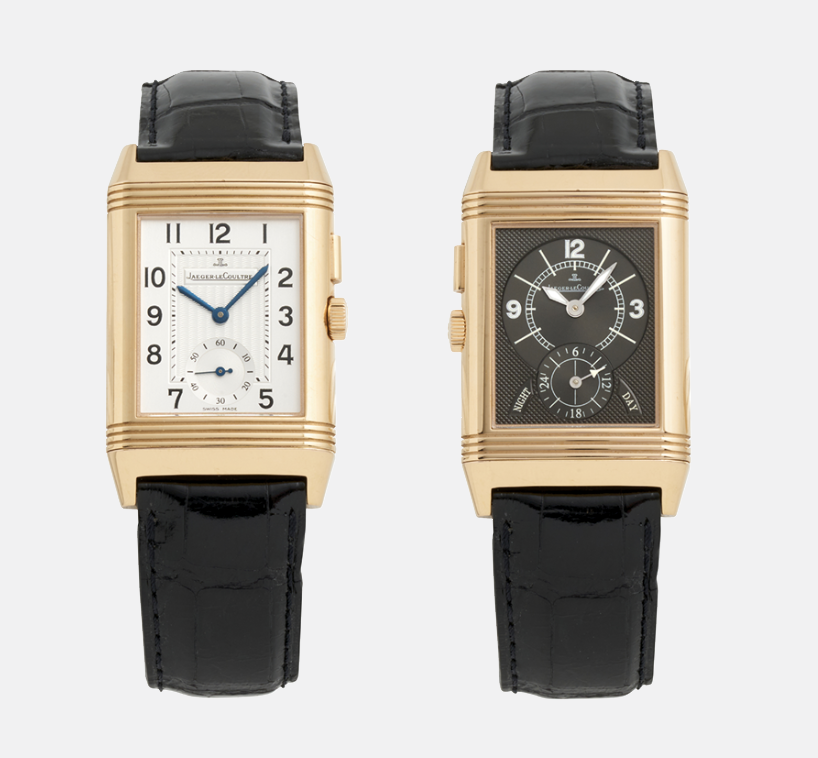
The Reverso was seen as embodying the Art Deco spirit. Its sleek linearity and innovative industrial design found form in gold and Staybrite steel cases prized for being scratchproof and corrosion resistant. Notably the plain case back – unlike the dual-dial Duoface configuration of today – offered a generous surface for embellishment and personalised engravings, adding another aspect to its sporty-chic duality.
But just as we have seen previously, the course of horology rarely runs smoothly, and this early momentum was abruptly curtailed by the upheaval of the Second World War. Production slowed and shifting tastes back to round and military-specification watches rendered the rectangular, polo-oriented Reverso as increasingly unfashionable. The post-war decades did little to revive its fortunes with the disruptive rise of quartz technology.
Fortunately, a lifeline would be thrown when in 1975 an Italian distributor, Giorgio Corvo, who believed in the design’s financial potential, famously acquired the last remaining new old stock of unused and incomplete Reverso cases which lay dormant at the Jaeger-LeCoultre factory and had them fitted with small oval mechanical movements. The gamble paid off, and the Corvo Reverso sold out within months. By 1982, Jaeger-LeCoultre had officially reintroduced the Reverso in a line of watches that were equipped with mostly quartz movements, ironically the technology that once threatened its very existence.
Staying true to its essence as the first true sporty dress watch, established nearly a century ago on a polo field in India, the Reverso continues to celebrate duality, with day/night dials and dual time zone displays, never losing sight of its past as it continues forward as one of horology’s enduring marvels.
By Patricia Kontos, Senior Timepieces & Jewels Specialist
Top Image: Jaeger-LeCoultre Reverso Duoface wristwatch. Sold for $15,000
June 2026