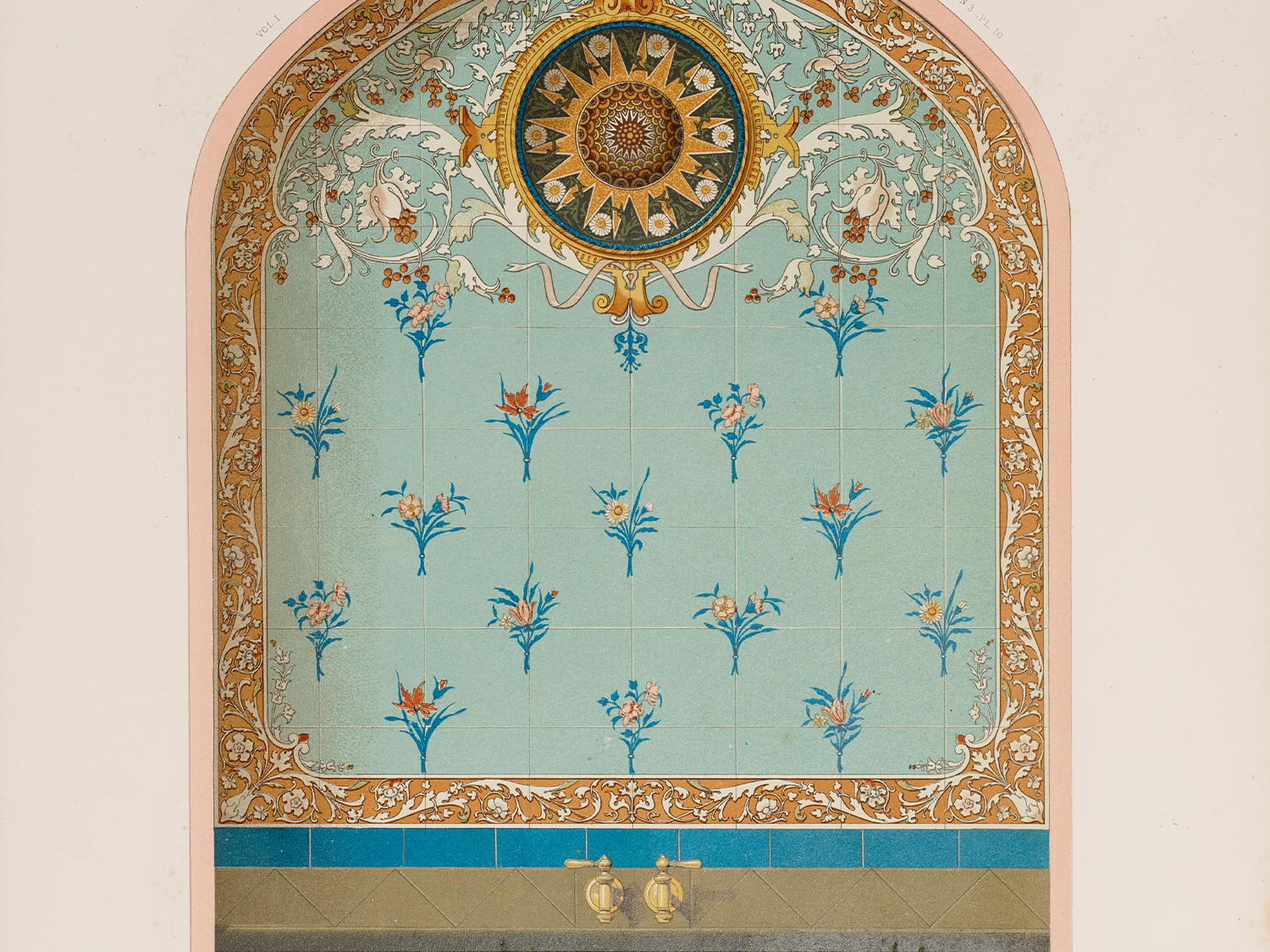
Urbanisation during the middle decades of the 19th century, together with the rise of an affluent and wealthy middle class, led to extensive development of new housing including fine townhouses in newly fashionable districts of major cities, namely New York, London, and Paris. As this spread, so did the development of the architectural profession and associated trades and businesses to cater for everything – from building the houses themselves to decorating and furnishing them.
The growing middle class of this time were very much engaged with contemporary designs and fashions through the birth of the international exhibitions starting from 1851, which showcased techniques and crafts from local and international designers and artisans. These led to a growing interest in ornamental and interior design on a wide scale.
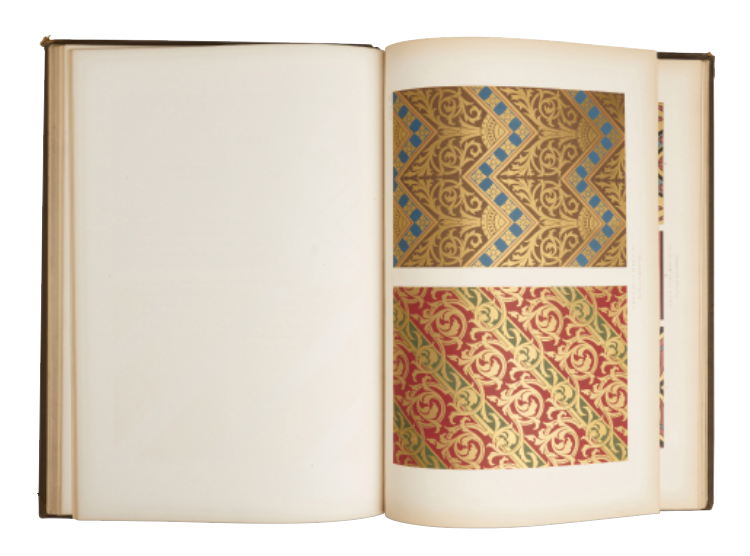
At the same time, modernisation and increasing efficiency in publishing coupled with technological advances such as the development of chromolithography raised architectural and decoration pattern books to new heights of sophistication, the finest of these being illustrated with rich plates in many colours including gold. The popularity of chromolithography grew, being highly prized for its vibrant colours and fine detail.
All this culminated in instructive books being published with chromolithographic illustrations, a vast contrast to similar books that had previously been published in black and white. The chromolithographic books provided dissemination of artisanal instruction, which both catered to the trades and their clientele.
One of the first and the most well-known books of this type is The Grammar of Ornament published in 1856 by British architect and designer, Owen Jones. Considered a seminal publication for the period, Jones had assembled 160 chromolithographic plates of ornamental designs from all over the world, extensively ranging from Asia to the middle east, including ‘savage tribes’ and ‘Egyptian’ designs. Jones had embarked on a grand tour visiting countries including Egypt, Italy, Greek, Turkey, and Spain. His publication was a summary of the design theories in thirty-seven key principles which he considered to be the ‘best’ he had documented.
Jones’ publication was the first of many that provided endless inspiration in the second half of the 19th century, matching the increasing sophistication of the clientele, as well as the architects, artisans, and tradesmen that served them.
Throughout this period, influential French architect, writer, and publisher César Daly published various volumes of pictorial guides illustrating private architectural designs including a two-volume set of painted interior decoration, which included fifty-five chromolithographic plates. This set detailed various colour combinations and designs for lounges, bedrooms, dining rooms, studies, entrances, and outbuildings, all in decadent designs fit not only for the nobility and the aristocracy, but also serving the rising middle class of entrepreneurs, merchants, and intellectuals.
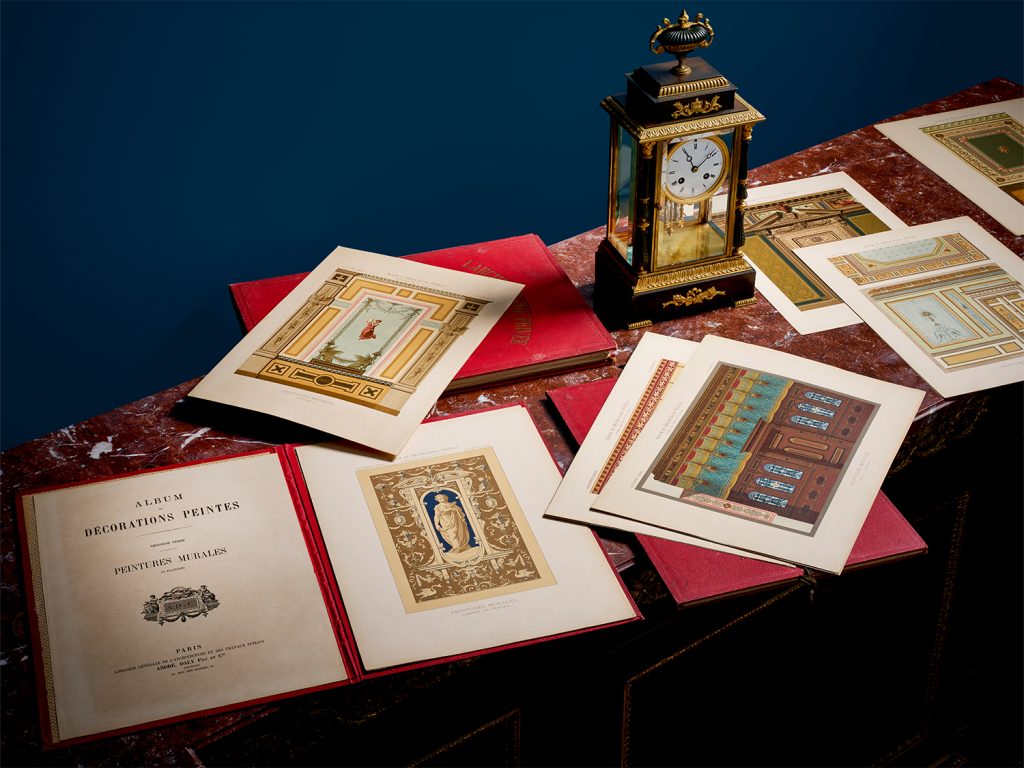
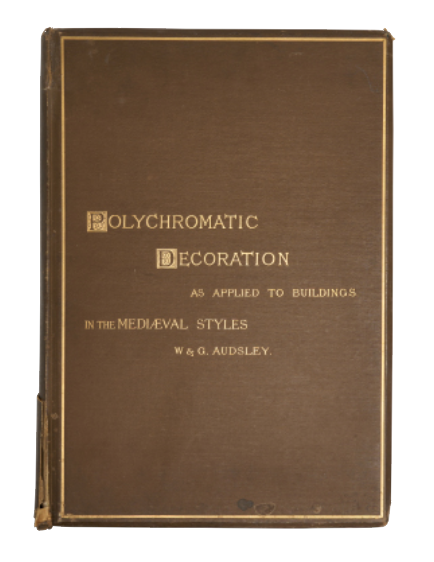
Former NGV curator and historian, Terence Lane OAM, had a huge affinity for interior design and traditional decorative ornamentation and within his library are various volumes of chromolithographic interior design pattern books, as well as their black and white illustrated predecessors, such as Peter Frederick Robinson’s Designs for Ornamental Villas and Designs for Farm Buildings. Examples of other chromolithographic books in this collection include a first edition of W. & G Audsley’s Polychromatic Decoration as Applied to Buildings in the Medieval Style and A.W Pugin’s Glossary of Ecclesiastical Ornament and Costume, together with a copy of César Daly’s Architecture Privée au XIX Siècle: Decorations Intérieures Peintes.
We look forward to sharing another insight into Terence Lane’s intellectual pursuits with this auction in August.
By Chiara Curcio, Head of Decorative Arts, Design & Interiors
Top Image: Daly, César, Architecture Privée au XIX Siècle: Décorations Intérieures Peintes, and two others similar. $700-900
August 2026