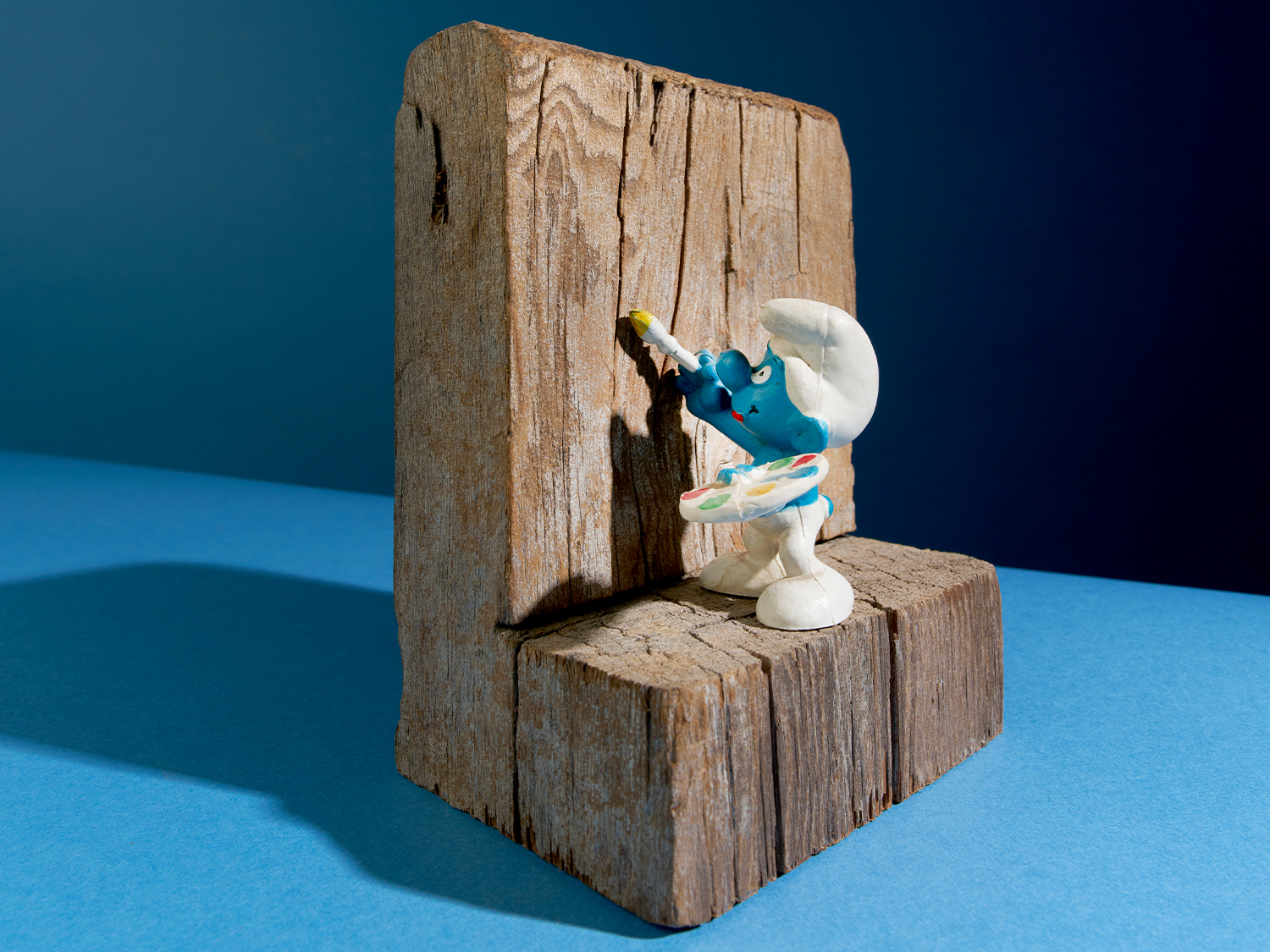
Ever since I first came across this playful and slightly enchanting mixed media piece, it has lived in my office at work. It’s by an artist and if properly catalogued its official listing would never quite capture its charm: Colin Lanceley (1938 – 2015), Untitled, mixed media, PVC and wood, height 14cm, provenance: The Artist’s Collection. All very correct, all very dry.
The real story is different. It was gifted to me by Colin Lanceley’s widow Kay, after the auction we conducted for their family. I’d admired it during the viewing period, but it had been considered too silly, too flippant to include in the auction itself. And so, it ended up with me, a vendor’s gift to the auctioneer. I was touched.
Like any work of art, it speaks differently to whoever looks at it. For me, the wooden block feels nostalgic. I can’t prove this, but I’ve always imagined it might have been Colin’s momentary nod to Rosalie Gascoigne. Or perhaps I’m overthinking it, and it was just two ordinary objects from his extraordinary studio – things that might one day have found their way into one of his monumental, complex constructions. But these ones didn’t. These stayed as I found them. Loose and playful.
And what it is, is simple: a 1970s Smurf. The Artist Smurf, in fact, perched loosely on a block of wood as though preparing to paint it. It also reminds me of my earliest encounters with miniature worlds; when BP in the 1970s collaborated with European and Asian manufacturers to produce tiny collectible toys, no doubt in hopes of luring more families and more children into their petrol stations. It worked.
For many kids, collecting them became an obsession. I remember my younger brother Ben earning enough money from retrieving and reselling lost golf balls to methodically purchase and complete the full set. He was the only person I knew who had the whole collection at one point.
Telling that story again and having our photographer Paolo shoot this little Lanceley sculpture, I realise I’m not just reminiscing, I’m working towards a broader reflection on the deep and sprawling world of miniature collecting.
We’re all familiar with the obvious categories: miniature portraits, dollhouses, tiny books. But what intrigues me most now is why humans are so captivated by smallness, why we’re drawn to the tiny, the delicate, the ridiculously detailed. In my 17 years now with Leonard Joel, I can think of numerous examples of miniature renderings that enchanted not just me but collectors alike.
By chance, a recent issue of The World of Interiors, December 2025, devoted itself entirely to the miniature. There were some wonderful reads, especially on the Rijksmuseum’s restoration of a historically significant dollhouse and the challenge of recreating microscopic porcelain and glass pieces that, after centuries, had cracked, absorbed moisture, and had begun to ever so slowly, crumble. The skill required to restore or recreate such things in 2026 is astonishing in itself.
Yet beyond the crafts and the ingenuity, I keep returning to the human impulse behind it all. Why are we compelled to construct, display, and marvel at these tiny worlds?
I’m drawn to the cute, the small, the intricate; and the more complex the miniature, the more beguiling it becomes for me. Some say the appeal lies in making the inexplicable feel explicable, the incomprehensible suddenly comprehensible, the expansive containable. A miniature allows us to control something fully, to see the whole world at once, and in doing so we experience a kind of intellectual dominion that real scale mostly denies us.
This is probably where I risk drifting into territory I don’t truly understand, so I’ll stop before I dig myself any deeper. Instead, I’ll simply point to a few interesting pieces on miniatures in the decorative arts, referenced below, and keep enjoying this odd little Smurf on his block of wood, who started all this thinking in the first place.
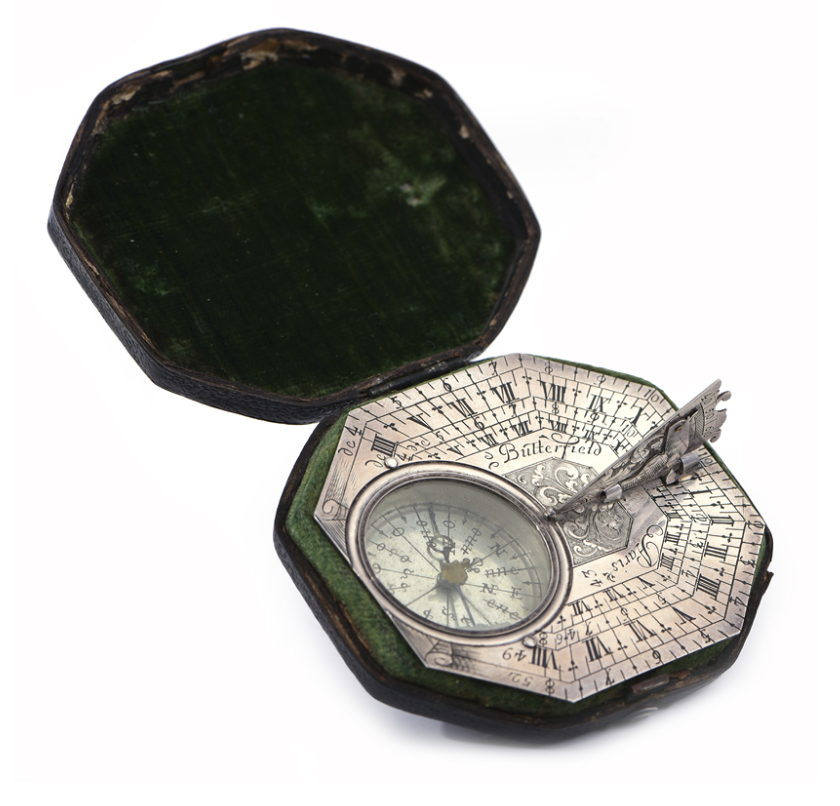
Oh, and what remains on my miniature wish list? A cased globe of the world, a Butterfield silver pocket sundial and yes, a complete and still boxed GI JOE French resistance fighter costume from the 1970s.
References:
Black, H.E. (Dec 2025) ‘Kraak Job’, The World of Interiors, pp. 68–71.
Small world: Why we love tiny things (2018) The Guardian. Available at: https://www.theguardian.com/global/2018/nov/04/small-world-why-we-love-tiny-things
Walkley, S. (2018) The world of miniatures: From simple cabins to ornate palaces. Lewes, East Sussex: Guild of Master Craftsmen.
By John Albrecht, Managing Director & Head of Important Collections
Top Image: Colin Lanceley (1938 – 2015) Untitled, mixed media, PVC and wood.
February 2026