
Tracey Judd Iva is an award-winning jewellery, object, and art historian, curator, writer and public speaker with a rich career forged at the National Gallery of Victoria, curating a number of significant international exhibitions locally and internationally before establishing ARTerior Cultural, a freelance cultural consulting agency. I spent an afternoon speaking with Tracey in the lounge room at Leonard Joel.
Tracey, you’ve built a fascinating career at the intersection of jewellery history, art, and curation. What first drew you to jewellery and ultimately led it to become the heart of your career?
My beloved grandfather used to say, “Find a job you love, and you’ll never work a day in your life.” That stayed with me.
I always loved art, art history, drawing and sketching, but I also always loved jewellery. My mother called me a little magpie because I loved anything shiny. I combined those interests through studying art history, museum management, curatorship and later gemmology. For me, jewellery has always been a wearable work of art and a means of self-expression.
Looking at Leonard Joel’s recent exhibition of Cartier, is there a particular jewel you found especially compelling?
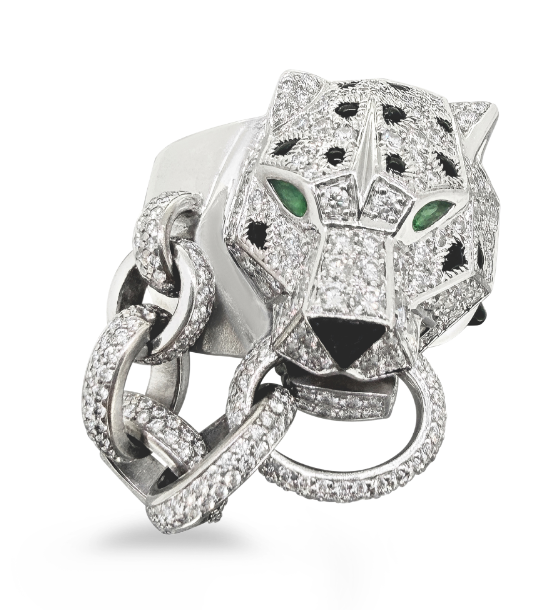
I have always loved the Panthère as a symbol and code of Cartier, and the collection contains wonderful examples across different periods. For me, the standout is the diamond, onyx and emerald Panthère ring. It reminds me of Epictetus: “First know thyself, and then adorn thyself accordingly.” This ring is for someone with a strong sense of self. The emerald eyes, onyx nose, and spots are instantly recognisable as Cartier.
How do you curate jewellery so visitors see it not simply as a beautiful object, but as a work of art combining social, historical, and cultural significance?
Curating begins with intellectual rigour. What is the argument? What story are you communicating? Every object must contribute to that idea. You place jewellery within its artistic, cultural and historical milieu: when it was made, what designers were doing and what was happening in society and human history.
Exhibition design, lighting, and interpretation support that story, but should never overwhelm the object. When I worked with Cartier pieces for the Victoria and Albert Museum’s Art Deco 1910–1939 exhibition, we deliberately minimised the human element and allowed the works to breathe.
Ultimately, a curator provides avenues through which people can enter into a relationship with an object, whether through scholarship or simply through its beauty, rarity and history.
Jewellery sits between art, fashion, design, and history. Has it traditionally been undervalued within the art world?
Yes, particularly when value has been determined by materials rather than artistic merit. I dislike rigid distinctions between “precious” and “non-precious”.
When I curated Bejewelled: Contemporary Jewellery from the National Gallery of Victoria, I wanted different materials considered together for their artistic significance. I also advocated for Dinosaur Designs to enter the NGV collection. At the time, someone asked, “Why should we bring plastic in?” My argument was that it wasn’t about plastic; it was about a changing artistic dynamic. Bakelite revolutionised costume jewellery during the Art Deco period. Resin represented another such moment. Interestingly, audiences responded particularly strongly to the Dinosaur Designs pieces. An internally flawless diamond, bakelite, and resin can all exist within the broader continuum of jewellery as art.
What can contemporary designers learn from historic jewellery houses, and what can contemporary jewellery teach us about historic pieces?
Historic houses teach emotional symbolism, craftsmanship, and the marriage of art and engineering. Historic jewellery also teaches theatre, fantasy, and drama. Contemporary jewellery, conversely, challenges us to look beyond financial value towards artistic integrity, using unexpected materials such as paper, plastic, found objects, and resin. There is a wonderful nexus between past and present; each informs the other.
How differently do museums and the commercial jewellery world value and communicate jewellery, and where is the most interesting crossover?
Museums primarily consider the object’s artistic, historical and cultural importance; commercially, an object must also have monetary value. The fascinating crossover is an exhibition such as Cartier at Leonard Joel. It was presented with a museological sensibility, yet visitors had the extraordinary opportunity to acquire a piece. That means becoming part of its continuing story.
Elizabeth Taylor understood that you don’t simply own great jewellery; you become its custodian. You preserve it, enjoy it, and eventually pass it to another generation. These pieces will exist long after us, carrying the stories of the people who wore them. Whether it is an engagement ring or a jewel bought to mark a personal milestone, part of our own story becomes embedded within it.
That is why seeing significant heritage jewellery destroyed or melted down is heartbreaking. Jewellery has a life and history beyond any one owner. We are simply its custodians for a time.
With thanks to Tracey for her time.
Top Image: Portrait of Tracey Judd Iva
October 2026