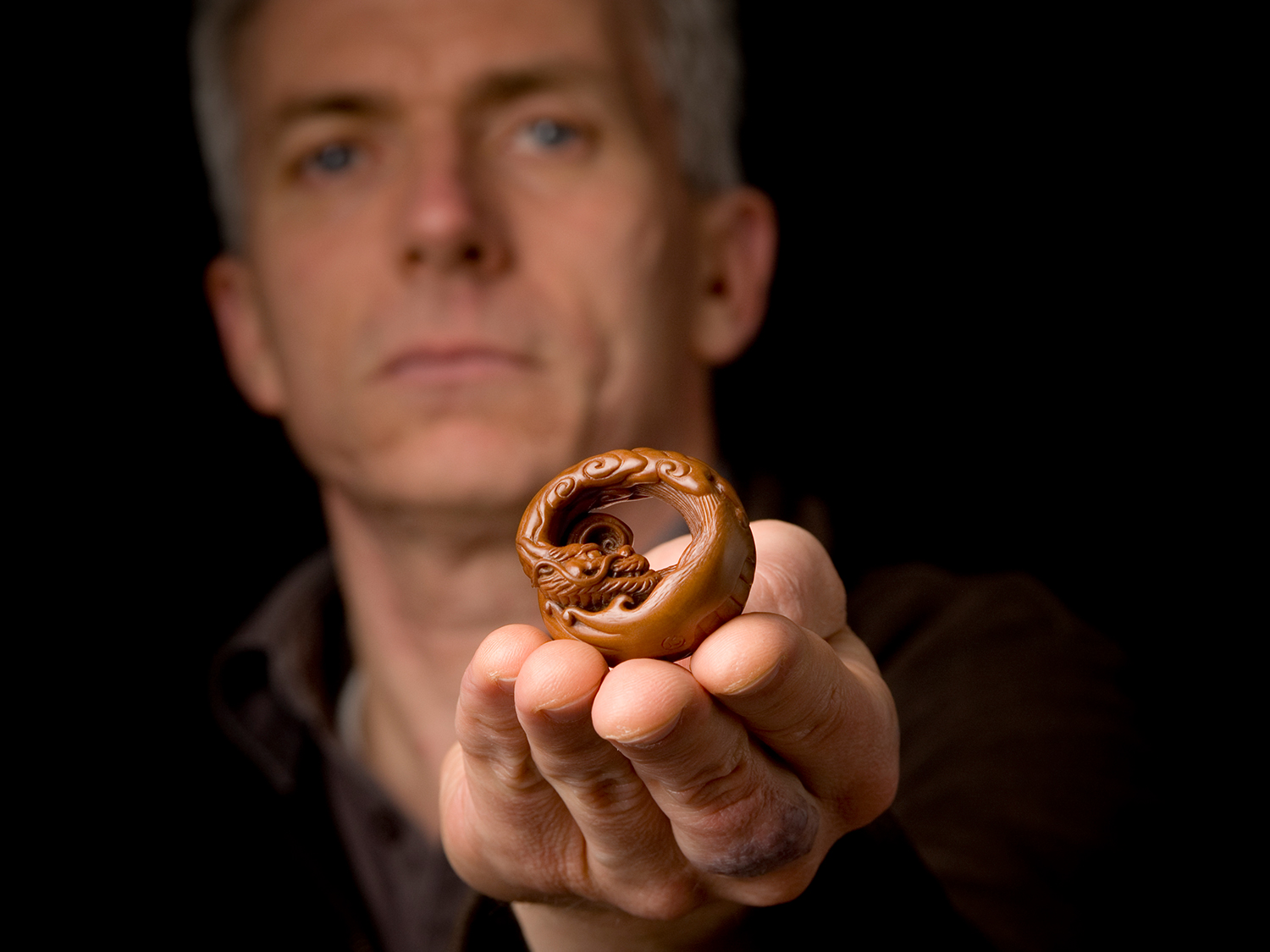
For more than three decades, Leigh Sloggett has been carefully shaping intricate animals in miniature, carrying forward the centuries-old Japanese tradition of netsuke carving. Since beginning his practice in 1992, Leigh has honed his craft under esteemed masters and currently works and exhibits in Japan. Here, Leigh shares some insights into this specialised craft, from its historical origins to its modern-day significance in Japanese culture.
Could you share a brief history of netsuke for our readers who may not be familiar with them?
Netsuke is a kimono accessory which originated in Japan in the Edo period as toggles to suspend items such as pouches or medicine cases from the sash (obi). Initially simple found objects that functioned for the purpose, they developed into highly detailed carvings in the 18th -19th centuries. With the introduction of Western clothing during the Meiji period, netsuke lost their practical role but are still carved today as collectible art objects.
What first drew you to the art of netsuke carving, how did you first learn the skill, and how did it lead you to move to Japan?
I have had an interest in netsuke since I found a small book in the school library when I was a high-school student. After finishing my studies in art and design at university and inspired by a trip to Japan I decided to go and study netsuke carving under Japanese contemporary carvers.
How do you approach a new netsuke, where do your inspirations for the designs come from?
Inspiration can come from many places, but I’m most inspired by nature – its elemental motion and animal behaviour. My designs are all original and I start by doing some very simple sketches, followed by making a rough model to outline the design in three dimensions.
Could you share the process of creating a piece?
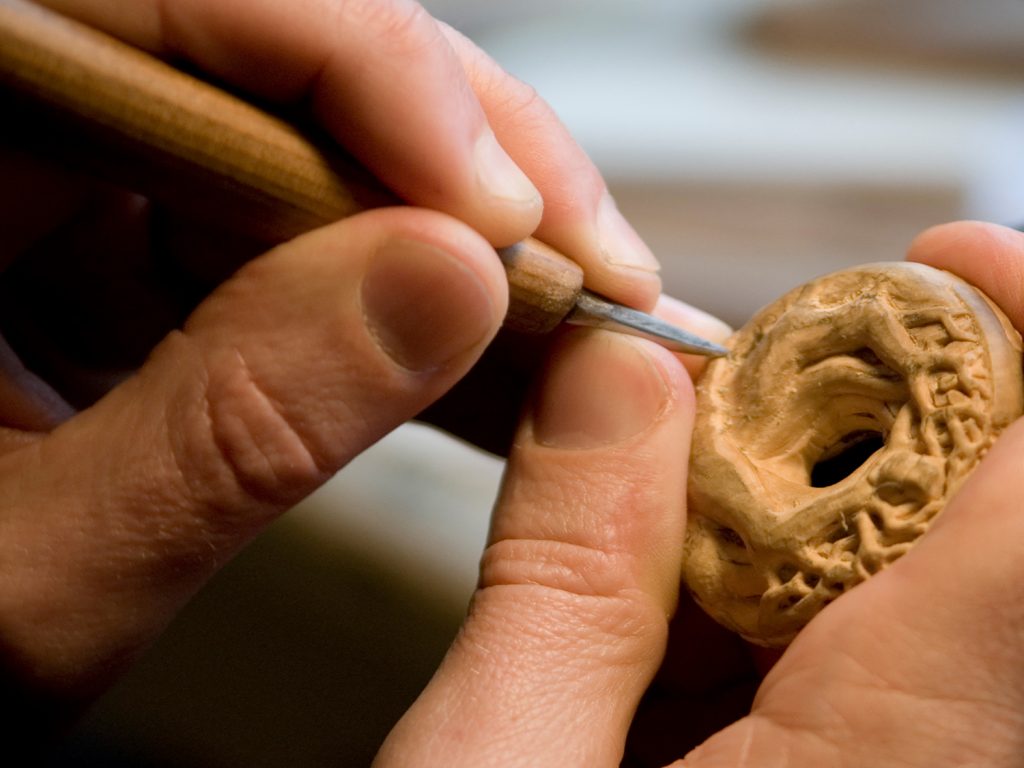
After the design work is done, I rough out the shape using saws, rasps and a dental rotary grinder. Then the details are slowly refined using a range of different shaped long handled scrapers. The next stage is polishing and often redefining the detail before staining and the final polish.
How do you decide which material to use for each netsuke?
The choice of material depends on what best suits the design, but it must always be appropriate for netsuke – dense enough to allow fine carving, take stain and polish well, and remain durable so the detail does not wear away easily.
What details set a masterful netsuke aside from an ordinary one, and what should collectors be looking for?
Several factors define a high-quality netsuke. One which the novice collector might overlook is the himotoshi (the hole made for the chord to pass through). On a good netsuke the artist has considered its placement both aesthetically and functionally and they have given as much attention to it as to the rest of the carving. It is integral to the design not an afterthought. Another thing to look for is the rendering of details like hands. In a masterful netsuke, the artist will have carved these well. Originality, expressive quality, and a well-considered design are also indications of a high-quality work.
Is there a particular piece of yours that you consider your personal favourite?
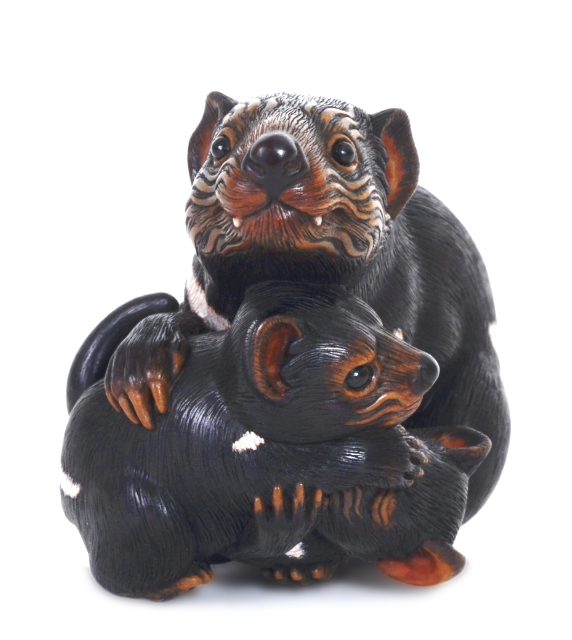
One piece that I’m quite proud of, titled ‘Rough & Tumble’, is this family of Tasmanian devils where the mother looks out while her two joeys play fight around her feet. This is probably the most complex piece I have carved.
What do you wish more people knew about netsuke?
Netsuke is a unique art form, possessing an inherent beauty rarely found elsewhere, one that arises from its functional purpose, resulting in objects that are both elegantly compact and intimately scaled.
With thanks to Leigh for his time. See more at leighsloggett.com
Top Image: Leigh Sloggett, portrait by Yusuke Sato
June 2026