
In this new series of conversations, we visit the ateliers of skilled artisans to learn more about interesting, rare trades and crafts. This issue, we chat to expert furniture restorer Jamie Neville-Young of Dealing in Design at his Melbourne studio, with music playing and his dog, Lenny, napping in the corner. Working across antique furniture, decorative arts, and modern design, his workshop is full of pieces in various stages of restoration, from an opulent Boulle piece circa 1850 to a Spade Sofa by Finn Juhl.
What first drew you to furniture restoration, and how did you learn the craft?
When I was in high school, I transferred out of Web Design and into Design Technology for years 11 and 12. I was sitting at the computer, staring out the window, and all I could think about was, what’s going on inside that workshop? Luckily, Mrs Bourke, the Design Tech teacher, allowed me to join the course and with her help and support, I made a Japanese-style bed using only joinery, no fixings. From that moment on, all I wanted to do was make things and spend my time in a workshop environment. I couldn’t believe you could spend your days sticking pieces of wood to other pieces of wood.
When I left high school, the two things I loved were music and making. So, I played in a band, and I applied to every furniture maker in Melbourne. I approached Harlequin Antiques in High Street, Armadale. They had listed a position for an entry-level restorer. I had never been into a shop like Harlequin before, I had never been to Armadale before, and I had never seen this kind of furniture before. I was blown away. The day of the interview, hilariously, I wore a suit. I was 18, and I got hired. I worked there for eight years, doing 50 hours or so a week. I studied Furniture Making at Holmesglen every Wednesday, and I studied a diploma of Building Construction in the evenings.
However, I learnt everything I know about restoration from our foreman, John Atkinson. John was from the East End of London. To this day, he is the greatest restorer I have ever seen. He was in his mid-60s when I met him in 2009, and he had been restoring since he was 14. There are simply not enough hours in the day to drain the priceless knowledge from his incredible brain. I was very lucky, and I am so grateful I had the good fortune to learn from him.
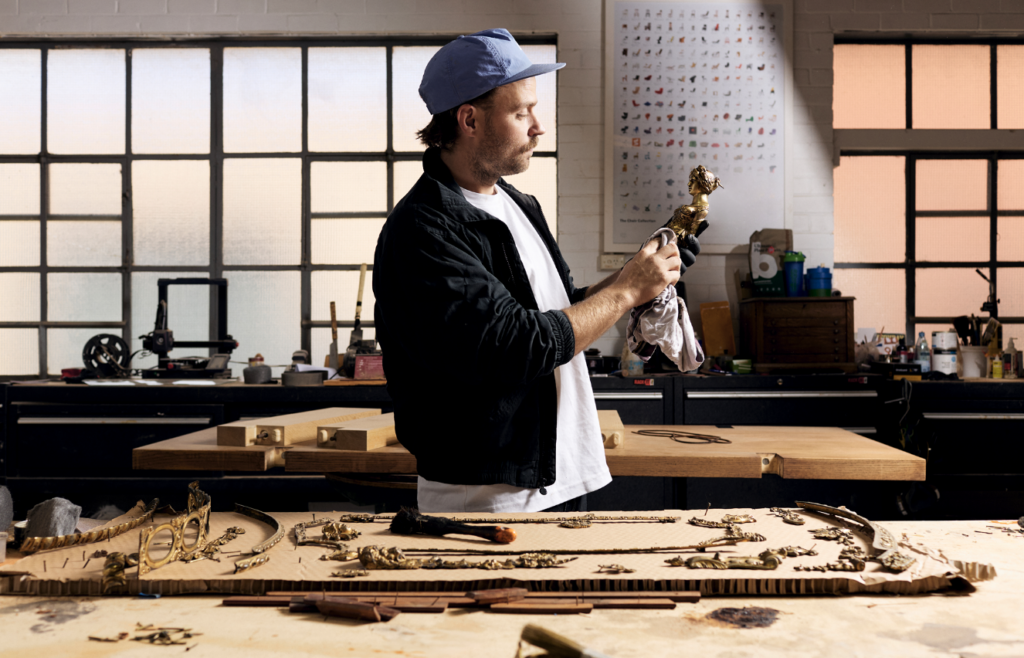
Take us through a typical day in your workshop.
Well, it seems the modern woodworker or restorer must not only restore but also film the process and post it to social media for our sins. So, it is not as quaint as it may seem.
Most days start with a coffee, likely a meeting, and then I work on restoring furniture for eight to ten hours. Those hours are punctuated by phone calls, client drop-ins, deliveries, and any number of distractions.
I like to work on four or five projects at once, ping-ponging between them and trying to keep my brain engaged in new and exciting problems. I often do deep work late at night or on Saturdays and Sundays. I find I can work on difficult and complex restorations when no one is around and the phone doesn’t ring.
Are the techniques, tools, and materials used for antique restorations different to those required for mid-century pieces?
The tools are similar, the materials are similar. A chisel is a chisel, brass is brass. But there are differences in technique, products, and approach. I could riff on this for hours. However, I believe that to be an adequate furniture or decorative arts restorer, you must understand the chemistry of the products you’re using at a fundamental level. You must also understand what finishes and materials are period-specific.
For me, this was learnt over 16 years of working on pieces spanning 300 years of different designs, styles, and eras. You must know when to utilise shellac, oils, solvents, lacquers, water-based stains, spirit stains, varnishes, and more. You must understand how these interact, how they stack on each other, and when to deploy them on different pieces and
materials.
How do you approach the balance between restoring a piece while still keeping it “original”? And when might something be beyond repair?
I could write the whole article on this question. Firstly, as a restorer, my goal is to retain as much of the original maker’s work as possible and retain all the stories the item has accumulated over its life. However, over a long enough time horizon, what is original?
My general opinion on this is that inaction is an action. If we were to leave the Mona Lisa and never perform restorations, it would soon cease to exist. Is it original? No. Is Da Vinci’s brilliance still on display? Yes.
This question is a real Ship of Theseus situation. If a ship leaves port and, over its life at sea, all its components are slowly replaced and repaired as necessary, by the time that ship is retired, after a long life on the ocean, not a single component is original. Is it the same ship? Is it original? That is the philosophical situation we find ourselves in as restorers.
In my opinion, when restoring an item, if there is a moment during the restoration process where that item will cease to exist, that is too far gone. At that point, you are out of the realm of furniture restoration and into the world of furniture alteration or upcycling.
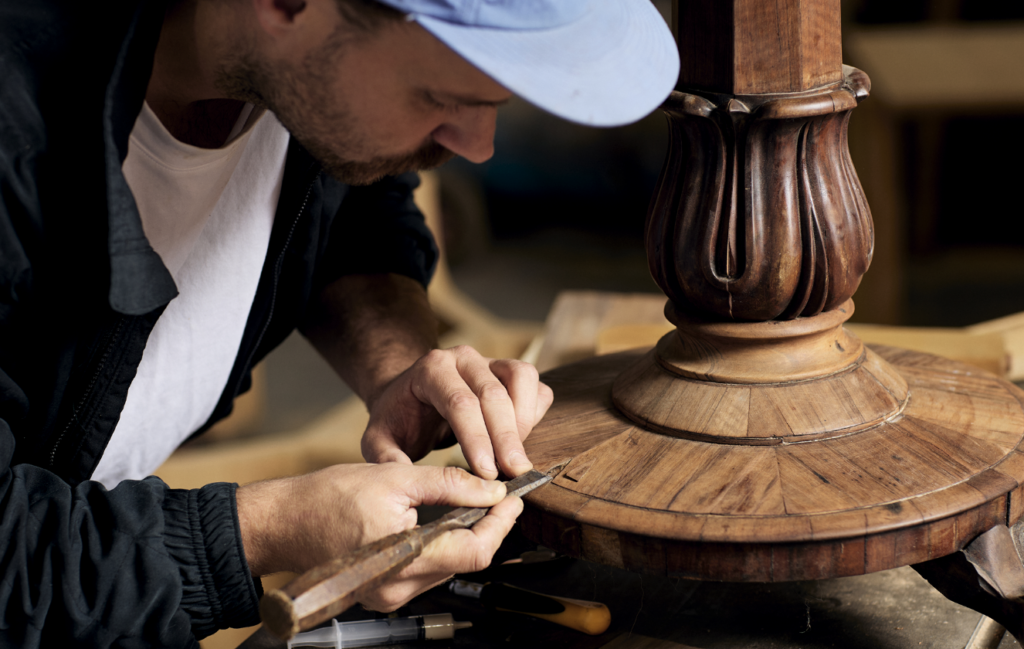
Can you tell us about a particularly memorable restoration that you’ve worked on?
This one is difficult, because pieces are memorable for many reasons. I remember restoring a desk for a client that went on to sell for $250,000 at auction.
I remember when I was an apprentice, I worked on a remarkable sideboard with curved glass. I spent about 50 hours restoring it. It required veneer patching and polishing. When I reinstalled the curved glass, on the final fixing, I shattered it with the last pin.
Do you think there are any small fixes or care tips people should know how to do at home?
The most restored household item is a dining table. In my opinion, they are the most meaningful piece of furniture in the house. They are the soul of the home. Please keep tabletops dry! If you must wipe down your tabletop, wipe it down completely. Don’t perform little spot cleans. Wipe the tabletop with a damp rag from end to end, in the direction of the grain, then buff the timber off with a clean rag in the same manner. This ensures more even ageing and reduces the chance of a strange, uneven finish appearing years down the track.
Is there anything you wish more people knew about your trade?
Sometimes I wish clients understood more about timber, its colours, its properties, and what different timbers are suited to. But that is really too much to ask. There is a lot to learn, it simply is not general knowledge, and that is the restorer’s job to explain.
Other than that, it is an incredibly dusty and dirty profession that is so very rewarding. It takes a long time to get good at, and in this modern world I am unsure how many people will learn these skills in the future. Being able to have an impact on an item, and on a family’s life, in such a tangible way through their belongings is truly an incredible feeling. Every week, every day, you can see things improve, and it is very easy to feel valuable and like you are doing some kind of good.
With thanks to Jamie for his time.
See more at dealingindesign.com and follow along @dealingindesign
Top Image: Jamie in his workshop
March 2026