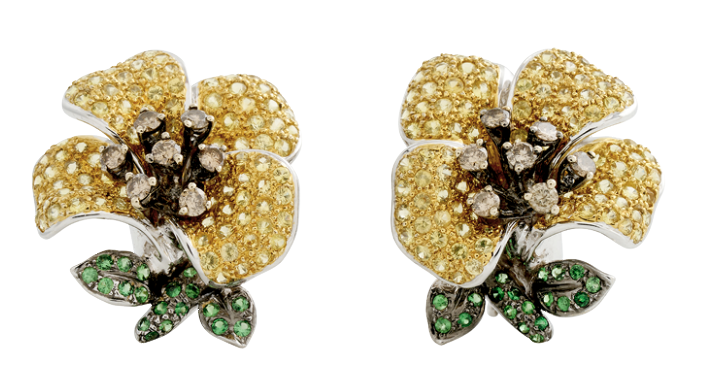
One year, when sending a stunning bouquet of flowers to someone close living abroad, I immediately imagined how I could capture its beauty in time as a cocktail ring. I have always loved how florals can be interpreted and made into wearable pieces. When you look at a flower, it is easy to imagine it rendered in gemstones and gold or silver as a piece of jewellery to adorn, such as an orchid, rose, camellia, pansy, tulip, or twisted vines of foliage.
My floral bombé would last forever, it could be worn always and not wilt or fade. Floral jewellery captures the loveliness of nature through craftsmanship, enabling us to wear geological wonders in gemstones formed over millennia, slowly growing in mineral environments with chemical trace elements determining their variety and colour. Imagine a corsage spray of diamonds, a colourful explosion of flowers of magnificence, or a perfectly styled single petal. Since ancient civilisations, jewellery designers and artisans have appreciated how flowers and gemstones complement each other, and the history of these motifs in jewellery has evolved along with design techniques.
Ancient Greeks and Romans commissioned gemstone carvings of garlands, and in ancient Egypt, collars and necklaces were adorned with lotus and papyrus flowers using carving and inlay techniques in turquoise, carnelian and lapis lazuli, symbolising rebirth. In the Middle Ages, just as floral motifs were used in art, literature, and music, they also appeared in jewellery. Pilgrims wore simple brooches or rings of carved metal garlands or wreaths and by the late Middle Ages, flowers became symbolic as filigree techniques were developed depicting blooms, ‘tussie mussies’, and posies, showing courtly love and chivalry. The fleur-de-lis, an iris, was adopted by early French and Italian monarchs in brooches and rings representing the church at first but spreading to central Europe depicted in the crown jewels of Prague and beyond. The Tudor Rose, a symbol created by Henry VII to represent the combining of the houses of Lancaster and York, was a common motif in the jewellery worn by the royal court.
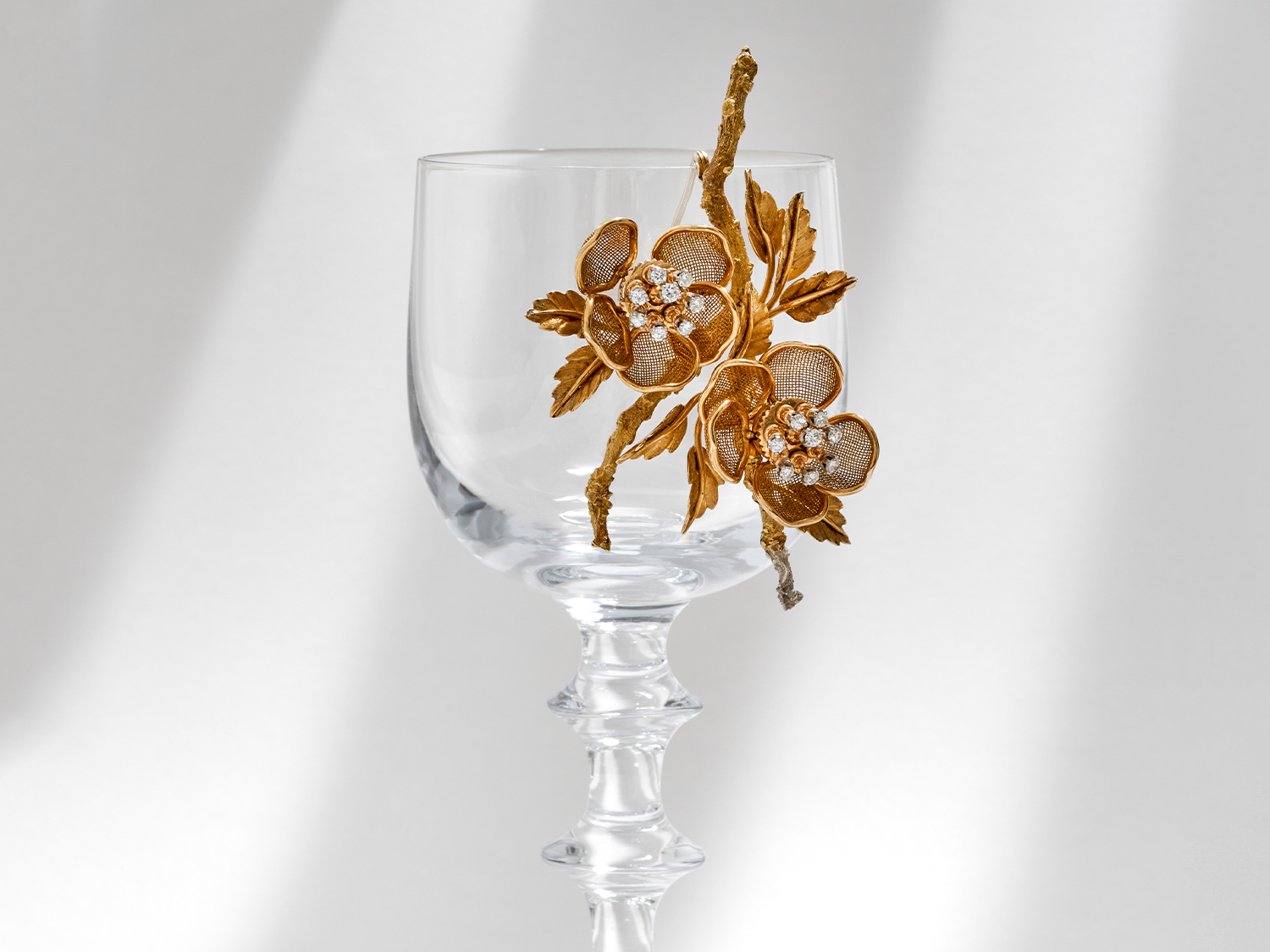
In the 18th and 19th centuries, during the Rococo and Romantic eras, floriography – conveying messages through the symbolic meaning of flowers – was popular in jewellery in the form of roses (love), daisies (innocence), and lilies (purity). Marie Antoinette favoured rose motifs woven into her jewellery, as seen in her floral diadem, a glittering spray of graduating diamond flowers elegantly arranged. The creation of the French ‘en-tremblant’ technique, where moving parts are attached by miniature springs and hinges, enabled elements of leaves, petals, flower heads, or branches to quiver as one moved.
Art Nouveau jewellery depicted stylised delicate floral sprays, often featuring orchids, blossoms, and foliage in coloured gems enhanced by diamonds to capture and reflect light.
Famous jewellery Maisons often use specific floral varieties in their signature designs, such as Cartier’s carved orchidé or tutti frutti, Chaumet’s hydrangea, Dior’s rose, Georg Jensen’s daisy, and Chanel’s camellia.
My ‘bombé de fleur’ ring is still in the early stage of gathering gemstones, but designers and collectors today, as throughout history, continue to prize the beauty of the natural world through adornment.
By Annie Soust, Head of Fine Jewels & Timepieces, Melbourne
Top Image: 18ct gold and diamond en-tremblant flower motif brooch. $6,000-8,000
February 2026