Inspired and mesmerised by many of the recent chandeliers Leonard Joel has had the privilege of selling, (special mention to the stunning Castorina & Co canopy of lights at the Gertrude Street auction viewing), I have been looking at the techniques of the traditional craft and towards its limits at a grand scale.
Chandeliers are sometimes referred to as the jewellery of an interior. And like important jewels that become as famous as the person who once owned them, there are chandeliers that take centre stage and have a life of their own in notable buildings.
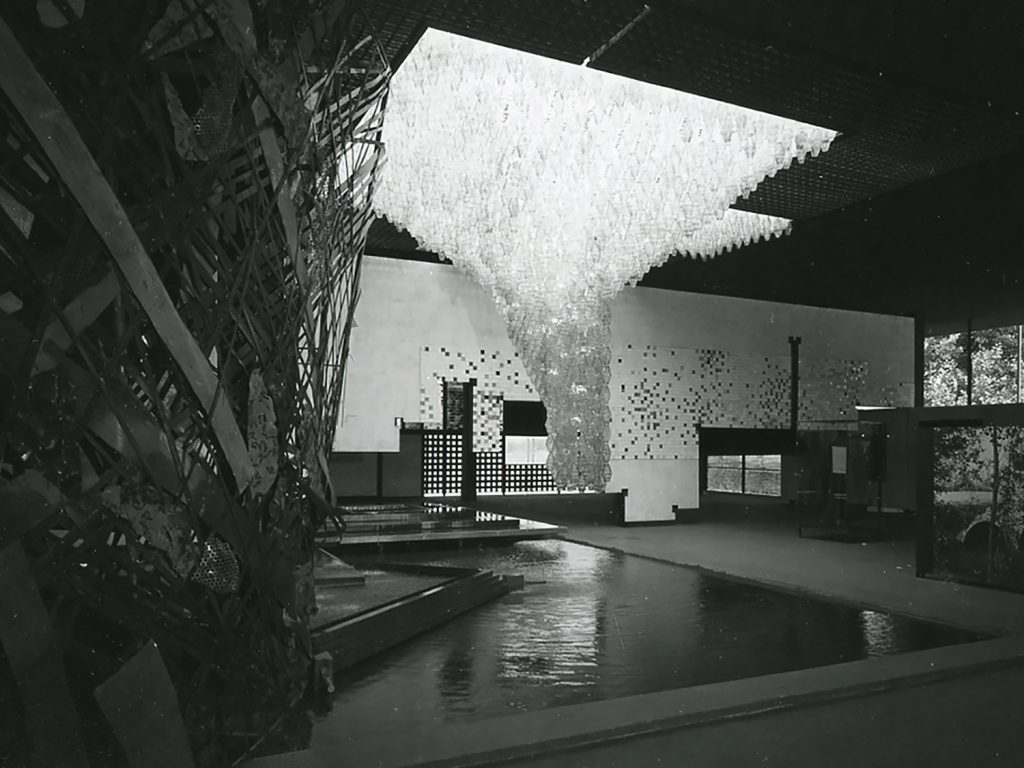
Let’s begin in Murano, where Carlo Scarpa spent decades pushing Venini’s glassworks toward something closer to sculpture than lighting. The Poliedri system, small hand-blown polyhedral “gems” of clear, pink, blue and amber glass threaded onto slender metal frames, emerged in the late 1950s as a remarkably versatile modular element. It was first employed on a monumental scale in the great Venini chandelier designed by Ignazio Gardella, Paolo Venini and Enrico Peressutti for the Italian Pavilion at
the 1958 Brussels World’s Fair. Scarpa later embraced and expanded the concept for the Italia ’61 exhibition in Turin, where a cascading installation of more than four thousand glass elements descended like a crystalline stalactite. Neither installation survives today, but together they established a new idea of the chandelier: an architectural form built from thousands of repeated units, hovering somewhere between light fitting, sculpture and geology.
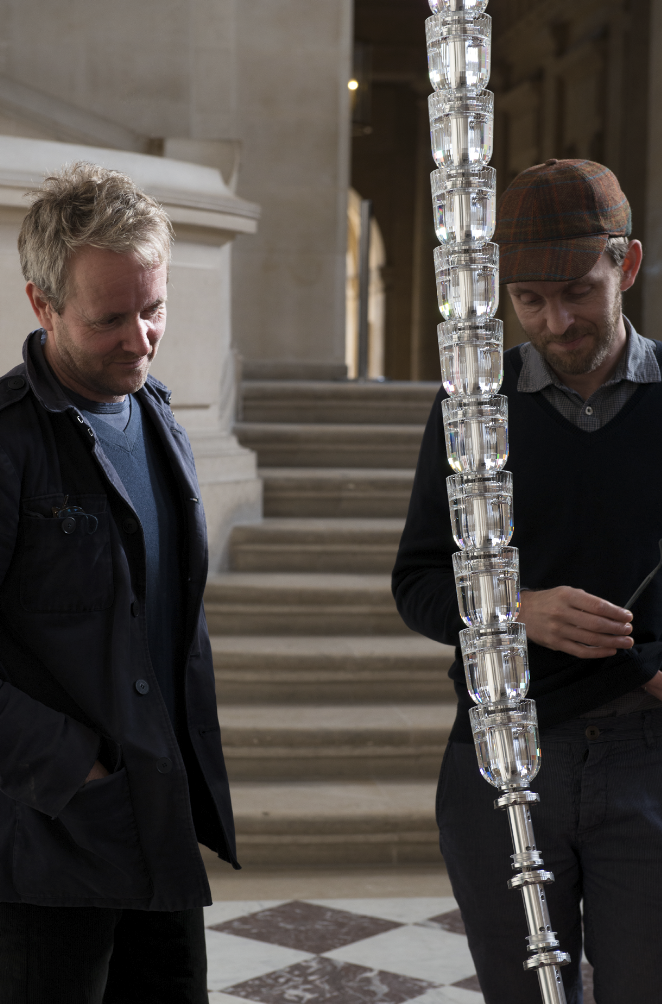
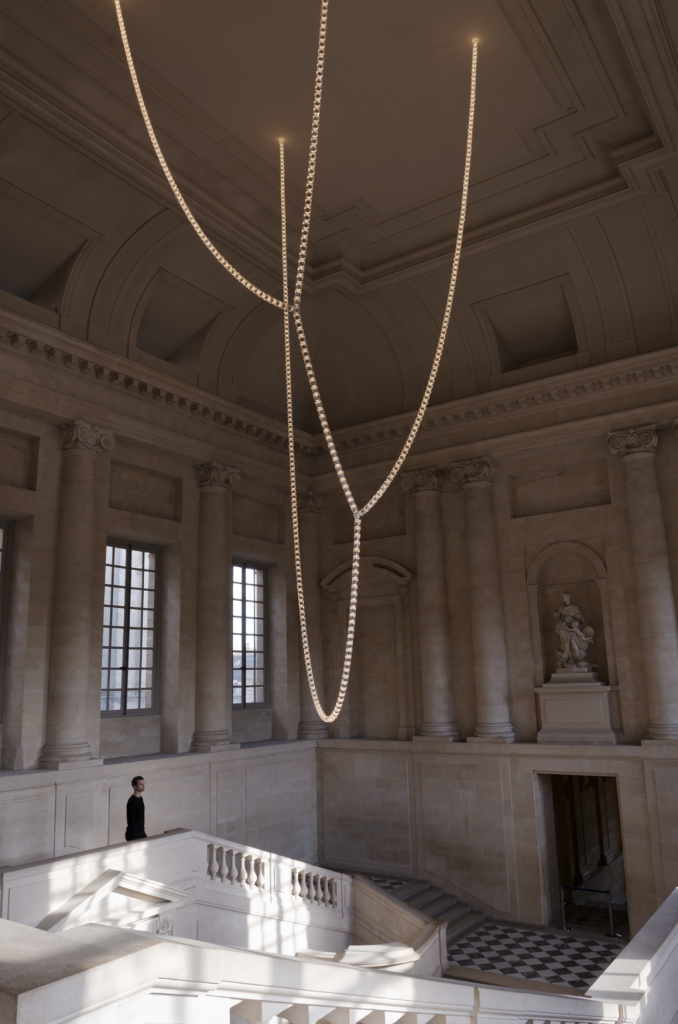
That same idea of accumulation, of a chandelier as thousands of small parts behaving as one continuous gesture, found its most refined expression half a century later at the Château de Versailles. In 2013, Ronan and Erwan Bouroullec were commissioned to create the palace’s first ever permanent contemporary installation: the Gabriel Chandelier, suspended over the Gabriel Staircase at the main entrance. Working with Swarovski, the brothers threaded some 429 lighting modules – 858 individually manufactured crystal shade halves – onto a stainless steel rope, engineered to nest and move like a necklace, with tolerances between components of just 0.1 millimetres. Rather than draw the chandelier’s form, the designers let gravity decide it, allowing the crystal chain to settle into three natural, looping catenaries. Standing twelve metres tall and weighing half a tonne, it is proof that even in a palace defined by 17th-century opulence, a chandelier can still be genuinely new.
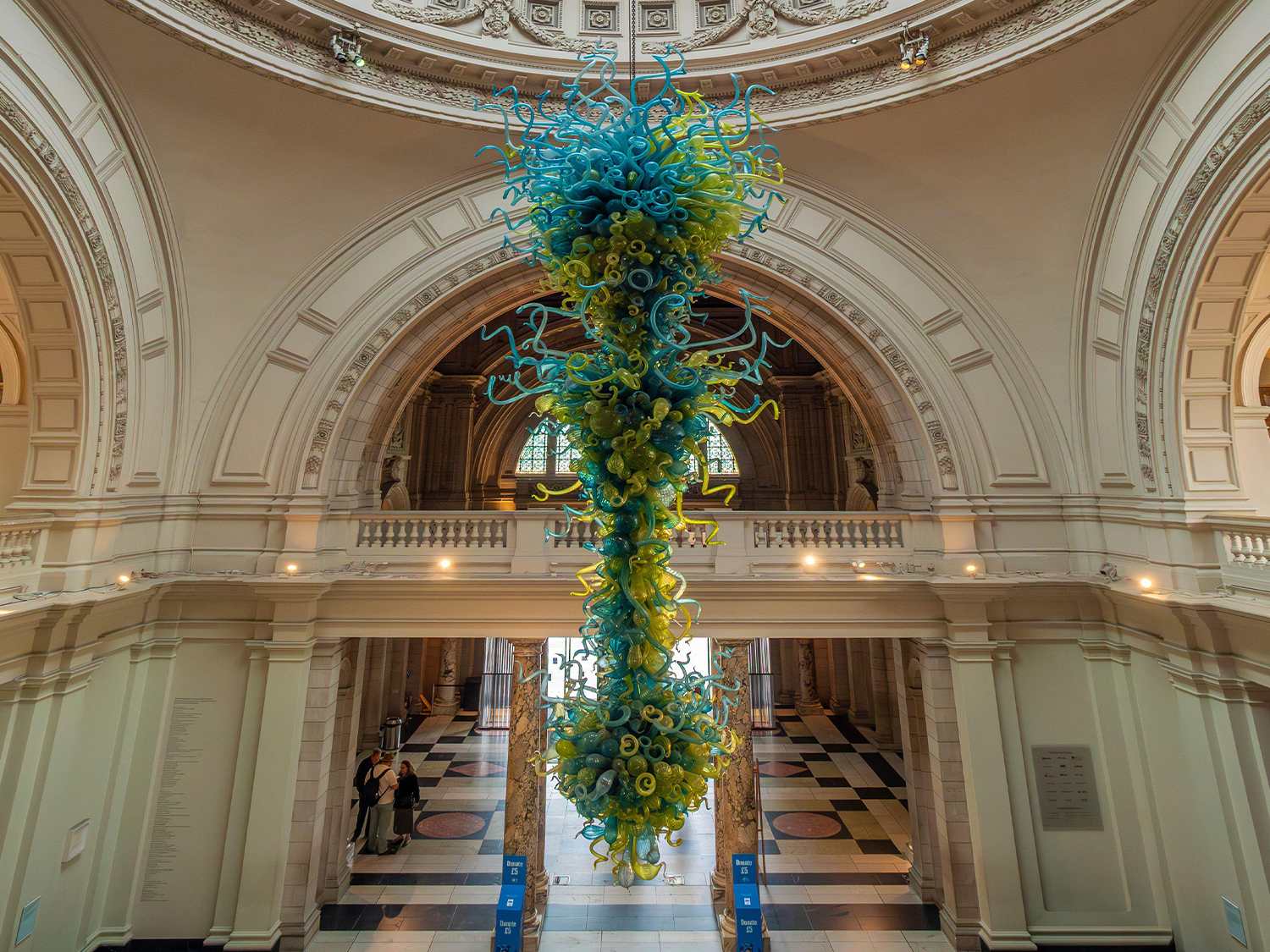
Where Scarpa and the Bouroullecs pursued precision and repetition, Dale Chihuly went in the opposite direction entirely. His 2001 chandelier for the entrance rotunda of London’s Victoria and Albert Museum abandons geometry altogether in favour of exuberant, organic excess. Made of over a thousand individually blown and mould-blown glass elements in ice blue, spring green, and yellow, each piece was hand-wired one at a time onto a welded steel armature, a process that took a team of six more than five days. The result reads less like a light fixture than a living organism suspended beneath the glass dome, unmistakably Chihuly’s, and unmistakably a descendant of the same Murano glassblowing tradition that shaped Scarpa’s Poliedri decades earlier.
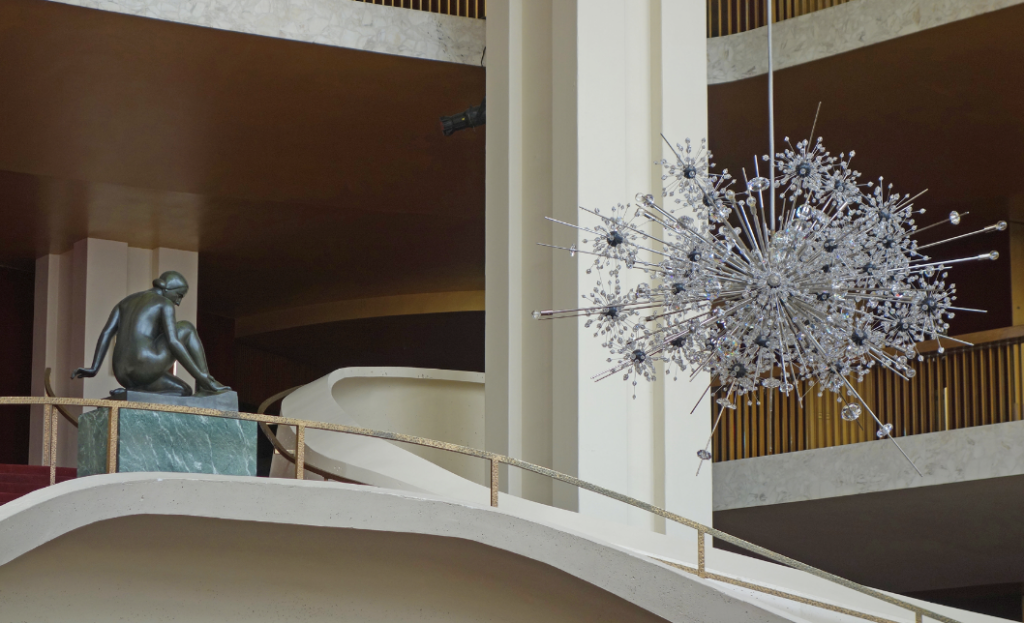
And then there is a chandelier born of diplomacy as much as design: the starburst fixtures of the Metropolitan Opera House at New York’s Lincoln Center. Designed by Hans Harald Rath for the Austrian firm J. & L. Lobmeyr, the twelve chandeliers were a gift from the Republic of Austria, offered in gratitude for post-war Marshall Plan reconstruction aid. When they rose toward the ceiling with the first curtain on opening night in 1966, they drew the evening’s first applause – a moment of pure theatre before a note of music had been played. Inspired by newly available photographs of distant galaxies, their sputnik-like form captured the space age optimism of the era, and today a single restoration of the eleven chandeliers required painstaking work across 51,500 crystals and 800 sputnik elements. Few fixtures anywhere have become so completely synonymous with the building that houses them.
By Rebecca Stormont, Senior Modern Design Specialist
Top Image: The Victoria and Albert museum Rotunda Chandelier by Dale Chihuly / Alamy
October 2026