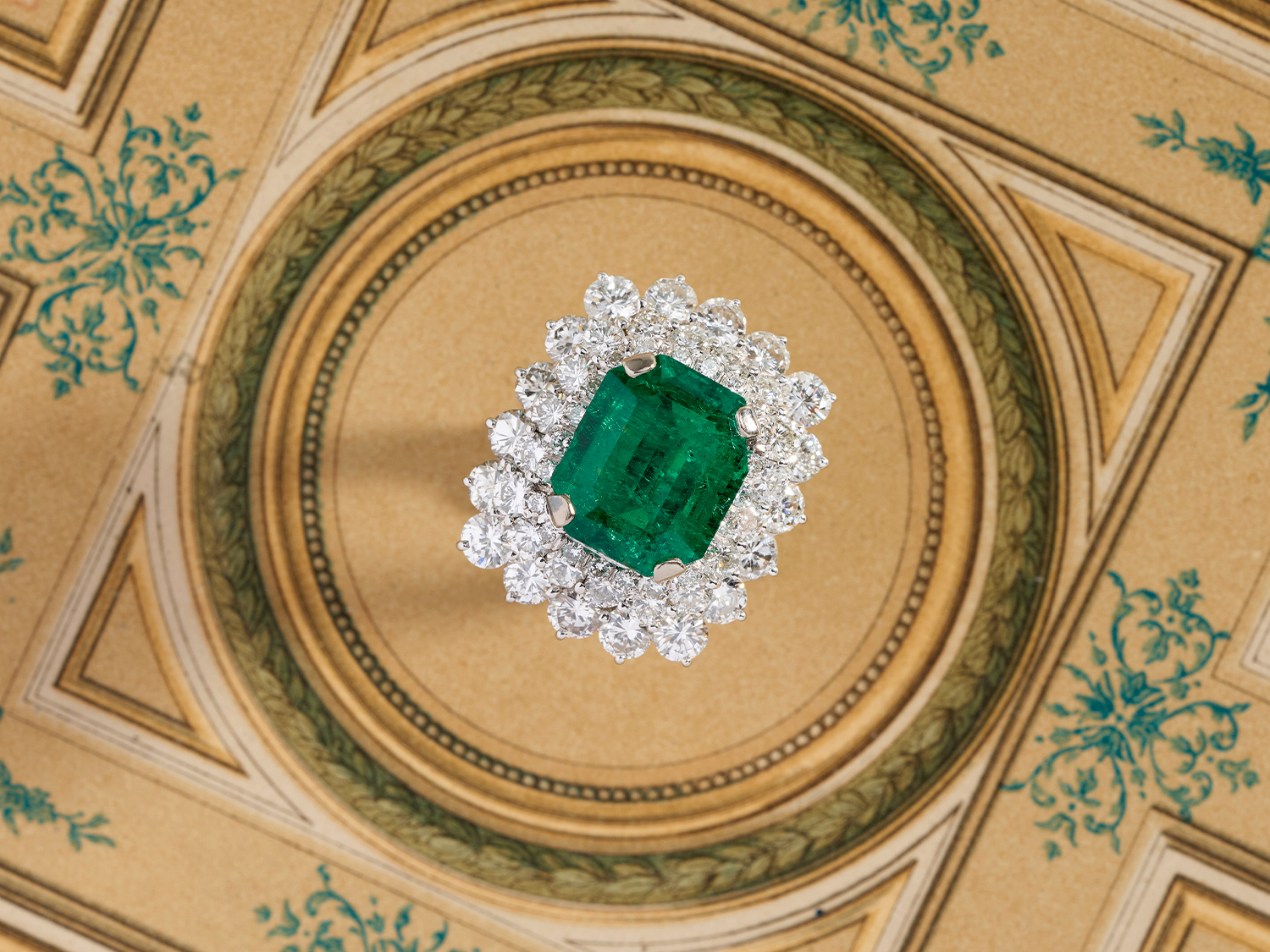
One of the most famous engagement rings in history began as a single large rough Colombian emerald, before being cut into two stones. One of these was then cut and faceted, resulting in an alluring 19.77 carat emerald. The deep green stone, possibly from the famed Muzo mines, was purchased by Cartier and transformed into a masterpiece.
Set in platinum and yellow gold, surrounded by a diamond halo, and with a now famous inscription inside the band, “We are ours now 27×36”, the ring is a love token, a unique and bold statement, and more importantly, a piece of history from the time of the abdication of the British throne, presented by Kind Edward VIII to Wallis Simpson in 1936.
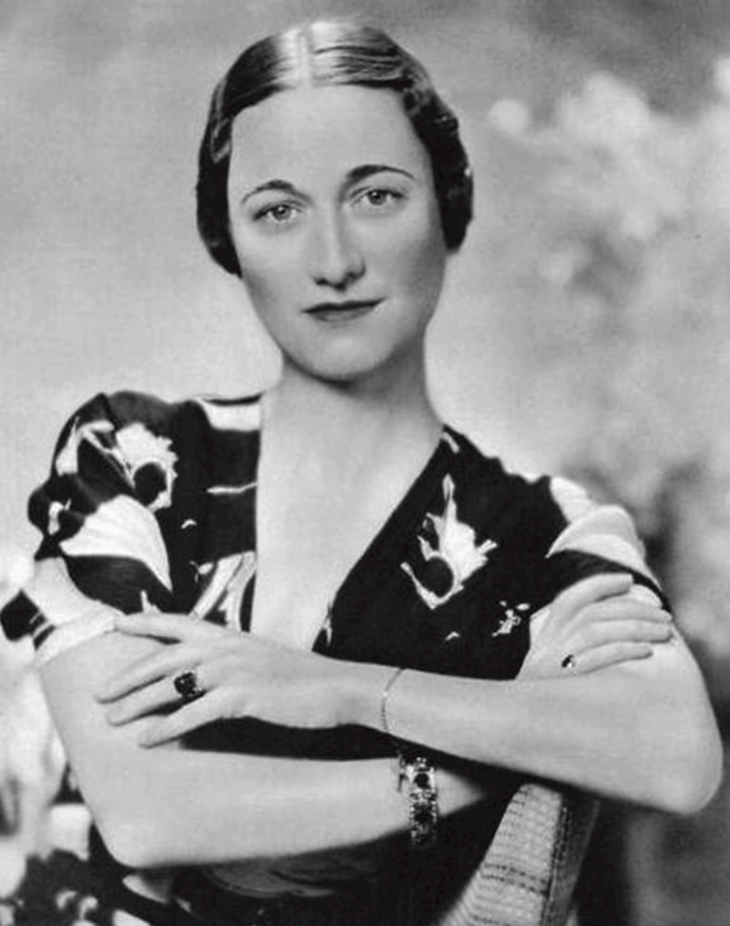
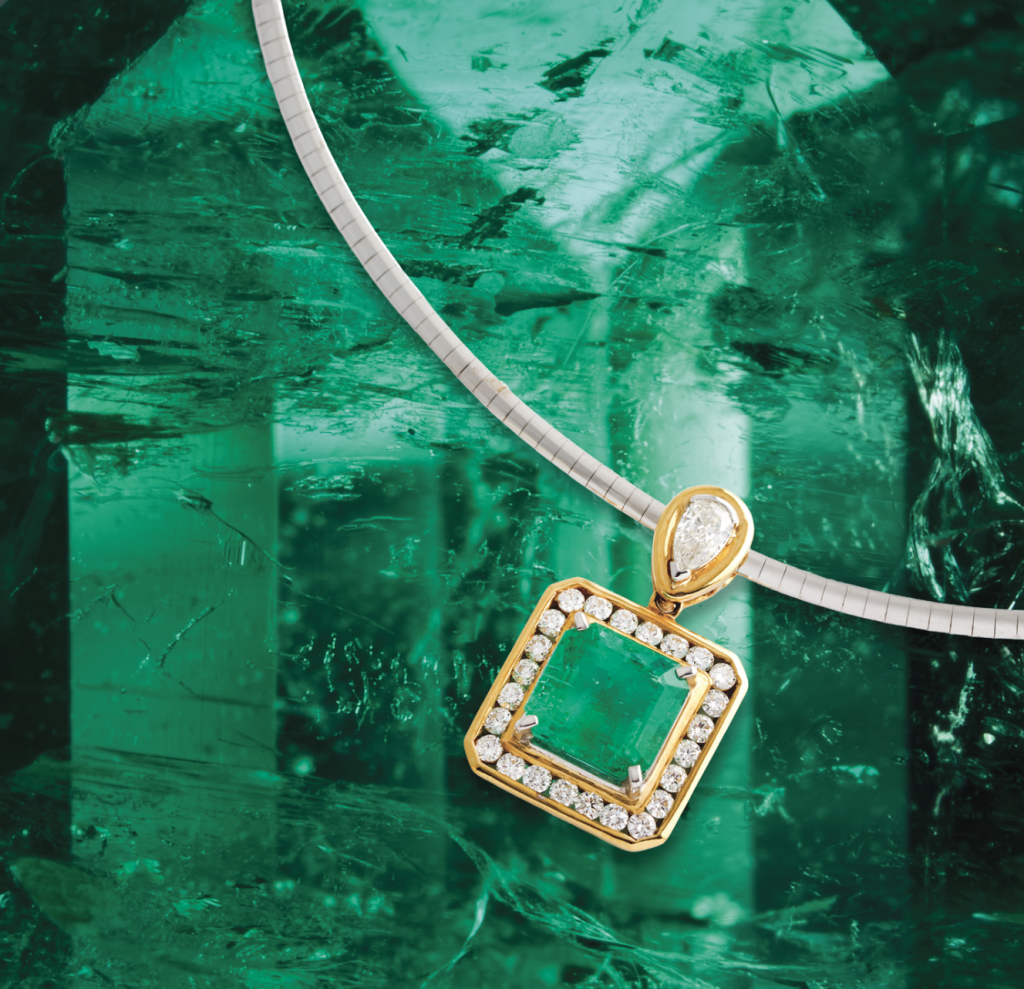
What makes Wallis Simpson’s emerald compelling is not just its size, but its character. Colombian emeralds, particularly those from the Muzo mines, are known for their blueish-green colour, deep saturation, and soft, velvety depth. For inside a beautiful emerald is a “jardin”, or garden, of inclusions – minerals, liquids, or gases trapped inside a stone during its formation. Light softly diffuses around these natural inclusions that when viewed through magnification show another glowing and captivating world.
In 1953, across the Atlantic, John F. Kennedy presented Jacqueline Kennedy with an engagement ring comprising a “toi-et-moi” of a diamond paired with a 2.84 carat emerald, set side by side and framed by baguette cut diamonds, made by French jeweller Van Cleef & Arpels. Another symbolic ring, the diamond represented clarity and the enduring tradition of the Kennedy family, while the emerald quietly suggested sophistication and individuality echoing Jackie’s sensibility and cosmopolitan appeal. This less than conventional engagement ring was a statement in design, not as bold in size as Simpson’s, but a contrasting statement of modernism and controlled, inimitable style.
Again, the emerald is believed to have been mined in Colombia, presenting the alluring jardin, with sought-after hues of blue-green with moss like inclusions, likened to an underwater garden.
Colombian emeralds were historically traded in India and carved with floral motifs representing paradise, such as the 1695 Mogul Mughal Emerald, associated with the reign of Shah Jahan, who commissioned the Taj Mahal. It is a monumental 217.80 carat emerald, unlike anything previously seen in Europe. Mughal emeralds are defined entirely differently as stones are often carved, not faceted, size and presence outweighs clarity, jardins are admired and desirable as they enhance the artistry of carvings of floral and foliate motifs, and symbolism is central.
However the world’s largest emerald is a Zambian stone known as ‘The Lion’, weighing an incredible 5,655 carats and originating from the Kagem Emerald Mine. Zambian emeralds are relatively new, but cannot be overlooked, with their heritage just starting. They are vivid and often bright in colour, cooler in tone but with strong saturation, with less to little jardin, resulting in crisp, bold, and powerful gems.
Emeralds form when elements are brought into contact under just the right conditions, at just the right time in the Earth’s history; their beauty begins with improbability. A collision of elements within two entirely different geological conditions – one metamorphic, one igneous – they form and grow in fractured, mineral rich environments from Brazil and Colombia to Australia, Afghanistan, and Zambia. Fluids move through the crystallising gem as it forms, with ongoing interruptions to growth and formation creating the jardin within.
Emeralds endure not because they are clean, bright, and perfect, but because they are profoundly vivid and imperfect. From the velvety moss green depths of Colombian emeralds to the carved magnificence of Mughal treasures or the bold clarity of recent Zambian discoveries, each holds the imprint of its origin within. Look into an emerald to find a quiet story formed within the earth, an enduring reminder that true beauty lies not in perfection or flawlessness, but in depth, character, boldness, symbolism, and history.
By Annie Soust, Head of Fine Jewels & Timepieces, Melbourne
Top Image: Platinum, emerald and diamond ring. $32,000-42,000
June 2026