Australian contemporary photography doesn’t just ask to be seen, it asks you to look again. These are images that catch your eye with beauty, humour or polish, then quietly reveal something sharper underneath. Across very different practices, these artists show how photography can be seductive and strange, intimate and witty, all at once.
Petrina Hicks
Sydney artist Petrina Hicks makes photographs that feel suspended in time. Elegant, precise, and almost unnervingly calm, her images appear polished at first glance before something stranger begins to surface. Working with large format analogue photography, Hicks draws on mythology, fables, and art history to reframe the contemporary female experience through a distinctly Australian lens.
Originally trained as a commercial photographer, Hicks brings a sharp visual clarity to her practice. Her compositions are stripped back and meticulously controlled, where small details carry unexpected weight. Shells, animals, and bones recur throughout her work, creating tension beneath the surface of beauty. As she explains, “I am drawn to photographing humans and animals together, tracing the boundaries of each creature … I see the female alignment with nature and animal cycles as something powerful.”1
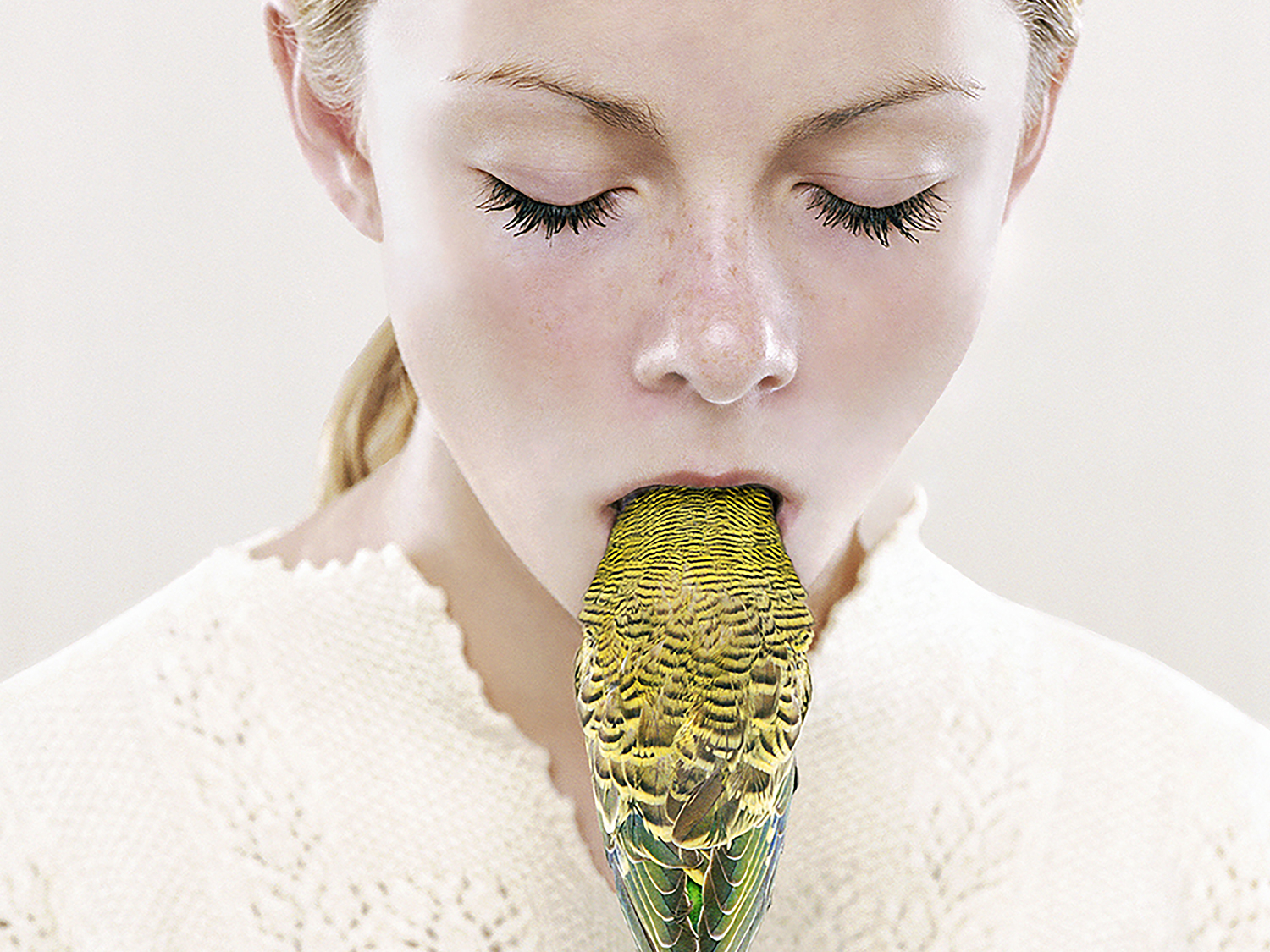
That balance between allure and discomfort sits at the centre of her practice. In Shenae and Jade 2005, a porcelain-like girl delicately holds a budgie in her mouth, producing an image that feels tender, surreal, and quietly confronting. Hicks has described the work as evolving intuitively in the studio, allowing the photograph to develop organically. The result is an image that feels familiar and unsettling all at once, a hallmark of her practice.
Dr Christian Thompson AO
Identity, memory, and place sit at the core of Dr Christian Thompson’s photographic practice. Working across photography, performance, and portraiture, he explores cultural identity as something fluid and evolving, challenging fixed ideas of gender, race and representation. His images are highly stylised yet deeply personal, balancing theatricality with intimacy.
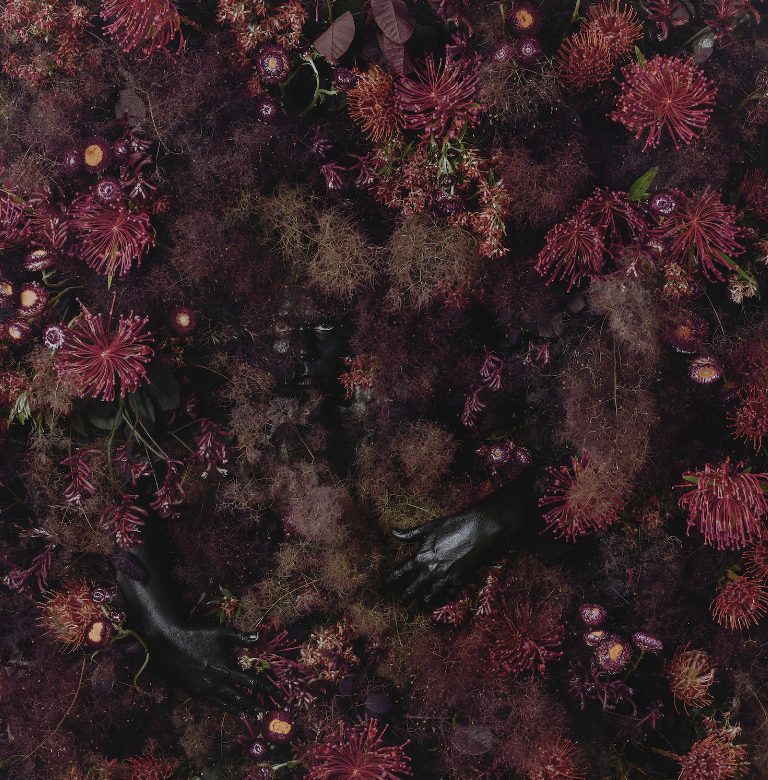
In his series Australian Graffiti 2007, Thompson draws on memories of growing up in the outback and the seasonal transformation of the landscape when desert flowers bloom. In these self portraits, his face is covered with bottlebrush, kangaroo paw and eucalyptus, at times almost disappearing beneath layers of colour. The figure merges with the landscape, suggesting identity as inseparable from place.
“When we were kids, my grandmother would always say ‘go out to the bush, all the desert flowers have come into bloom.’ The bush would really change at that time of year. All these beautiful flowers would bloom, and you would get muted purples and pinks and yellows, amazing colours. Australian Graffiti is really an expression of that.”2
Across his broader practice, Thompson adopts multiple personas through elaborate costumes and staged settings, expanding portraiture into something performative and shifting. Australian Graffiti remains one of his most recognisable bodies of work, combining softness and beauty with clear conceptual strength.
Destiny Deacon
Few artists reshaped Australian photography quite like Destiny Deacon. Since the 1990s, her work challenged how Indigenous identity is represented, using humour, satire, and discomfort to confront stereotypes head on. Playful, sharp, and deliberately provocative, her photographs sit somewhere between performance, storytelling, and social critique.
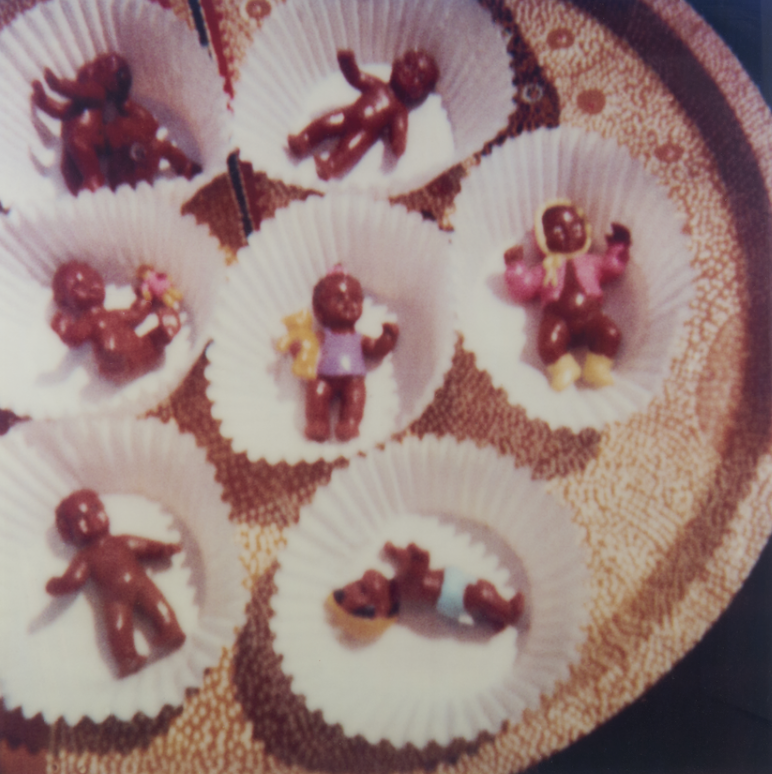
Deacon often staged theatrical scenes with friends, family, and herself as models, but some of her most recognisable works centre on black and brown dolls arranged among kitsch domestic objects. Limbs are removed, poses exaggerated, and familiar toys transformed into unsettling stand-ins for larger social narratives. Bold colour and intentionally awkward compositions give the images a surreal energy that feels both funny and confronting.
Her process often began with Polaroid photography, embracing blur and softness to heighten a dreamlike atmosphere. She later scans and digitally reworks the images, enlarging them while keeping the immediacy of the original moment intact.
“The thing is, you have got to make [the dolls] say something, to make them come alive, anyone can take a picture of a dolly. You have got to make them represent us with some issue, from my little heart of hearts.”3
Following her passing in 2024, Deacon’s work continues to resonate within contemporary Australian photography, remembered for its wit, honesty, and fearless perspective.
1. Petrina Hicks, quoted in Art Collector, issue 99, 2022, “50 Things | Curator’s Radar.”
2. Christian Thompson AO, quoted in House of Gold: Mediation Handbook, Museums & Galleries of NSW, exhibition education resource.
3. Destiny Deacon, quoted in conversation with Hetti Perkins, Art + Soul (television series),
reproduced in Art Guide Australia, 28 May 2024.
By Hannah Ryan, Senior Art Specialist, Manager of Speciality Auctions
Top Image: Petrina Hicks (born 1972) Shanae and Jade 2005. LightJet print, edition of 8. © the artist, THIS IS NO FANTASY & Michael Reid Sydney + Berlin
March 2026