In 1830s England a new ‘enthralment with the [fern] frond came out of nowhere’.1 Suddenly, interest in ferns, a botanical family previously largely ignored by most, was in the ascendant – an interest that would continue and find liberal expression in art and design throughout the following half century.
The new interest in ferns arose as a sub-interest within the wider new appreciation of the English countryside prompted by the Romantic imagination turning away from the less appealing aspects of the burgeoning industrial revolution, spurred by the Romantic poets and the theorists of the ‘picturesque’. This interest was soon broadened and heightened by images in art and books of spectacular fern-dominated landscapes in Britain’s colonies, especially the tree ferns and fern gullies of Australia, New Zealand, India, and the Caribbean, these touching on other themes in the Romantic imagination – awe at nature at its most overwhelming, and fascination with exotic landscapes that supposedly preserved a link with man’s Edenic origins (a parallel to the conception of newly discovered indigenous peoples as being akin to Rousseau’s ‘noble savages’).
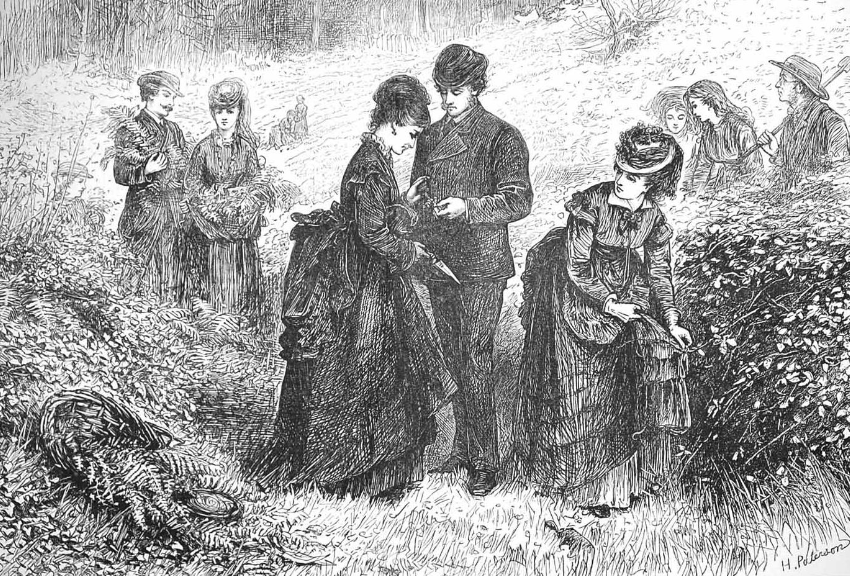
Before long, increasingly urban English society was pursuing its fascination with ferns in various ways. Enthusiasts were gathering in dedicated clubs to share their interest, hear lectures given by botanists, and organise excursions into the countryside to admire and collect their own specimens to enjoy at home – an early small-scale example of Victorian ‘rus in urbe’. This was facilitated by the rapidly-developed commercial availability of sealed glass terrariums, in which plants could be successfully transported – including across oceans – and maintained in an appropriate atmosphere, following experiments by various people during the 1820s and 1830s to develop these, most famously the ‘Wardian case’ designed by Nathaniel Bagshaw Ward and publicised in his books. Those of greater means could indulge in glazed conservatories attached to their houses or larger stand-alone glasshouses, which also began appearing in public gardens.
In the same period, advances in lithographic printing in colours allowed the publication in the middle decades of the nineteenth century of numerous books dedicated to ferns, accurately illustrating countless species. Relatedly, the pressing of fern specimens and artful arrangement of these in albums become one of the intelligent and artistic pastimes considered acceptable for gentlewomen to pursue. ‘Fern fever’ was not confined to this class, however, being shared by those of both sexes and of all classes and ages – and those further afield, particularly in Australia and New Zealand.
Thus, Charles Kingsley, in his 1855 book ‘Glaucus’ (which sought to encourage interest in other areas of natural history), coined a term for the fern ‘mania’ and lamented:
Your daughters, perhaps, have been seized with the prevailing ‘Pteridomania’, and are collecting and buying ferns, with Ward’s cases wherein to keep them (for which you have to pay), and wrangling over unpronounceable names of species (which seem different in each new Fern-book that they buy) …
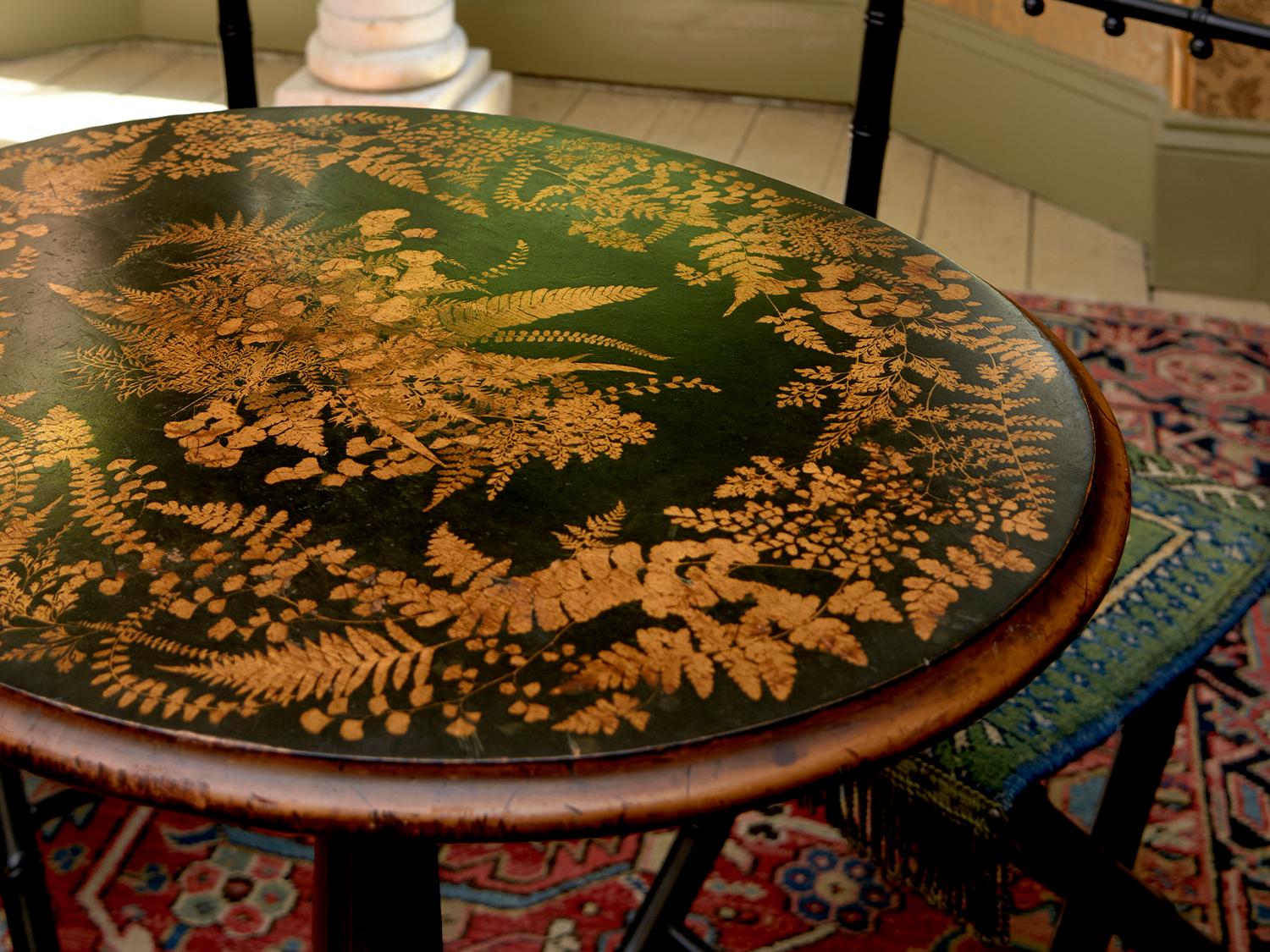
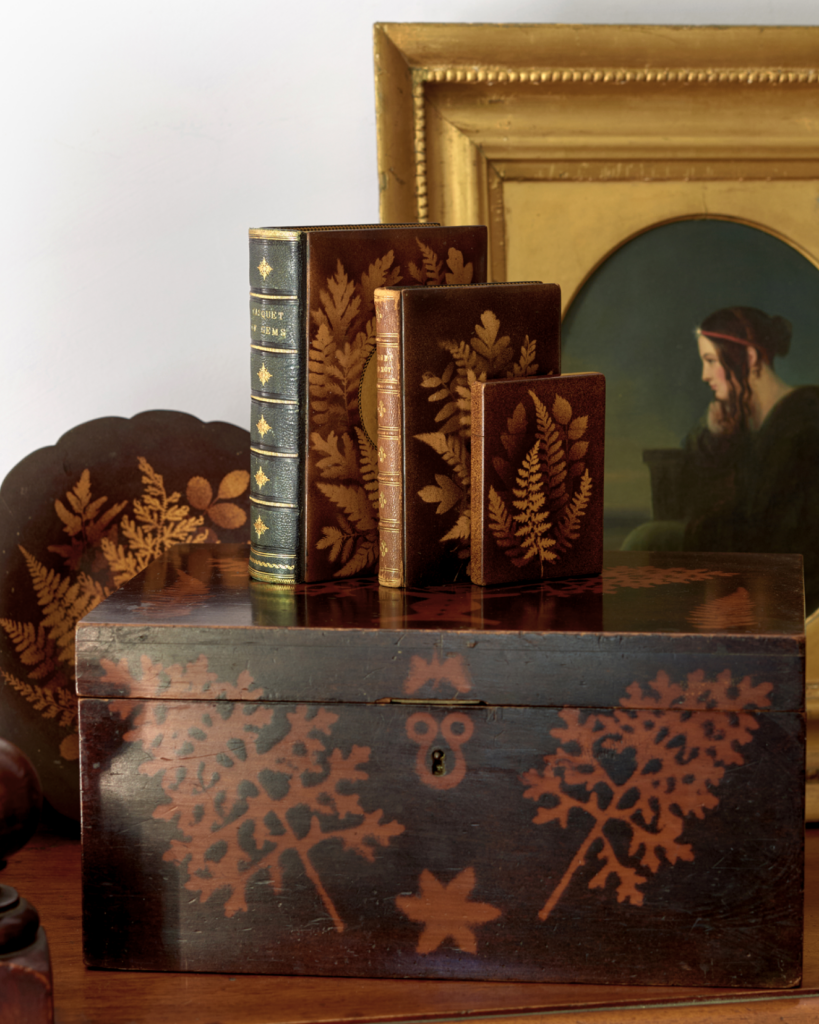
Kingsley’s lament and encouragement in other directions did little to contain pteridomania. To the contrary, its influence continued to broaden, inspiring the use of fern motifs across the decorative arts and interior design, both amateur and commercial, the latter being shown prominently at the great exhibitions of industrial arts of the 1860s and 1870s. At the height of pteridomania, fern designs appeared in various techniques and interior settings including carved details on furniture and architectural mouldings, on wallpaper and fabrics, sprigged and other decoration on ceramics, silver, and jewellery. Arguably, the most striking and successful uses of fern designs were in spatterwork decoration of furniture and other wood objects, using actual fern fronds for reverse stencil spray-painted decoration, and in cast iron designs, including Coalbrookdale’s famous 1858 ‘Fern and blackberry’ garden seat design, hallstands, and architectural lacework to balconies (many examples of which remain on Melbourne’s Victorian terrace houses).
Unsurprisingly, given its influence on Victorian design, pteridomania was a particular interest of Terence Lane, OAM (1946–2024), the esteemed historian of Australian interior design and former curator at the National Gallery of Victoria, whose collection Leonard Joel is honoured to be offering in two auctions in May. Examples of pteridomania in the first auction, which encompasses the main collection of furniture, objects, art, and a reference library, include a New Zealand-made album of pressed fern specimens, a fine spatterwork table, a cast iron stick stand after a Coalbrookdale design, a pair of finely modelled gilt wall lights, and ceramics.
1. Sarah Whittingham, Fern Fever – The Story of Pteridomania (London, 2012), p. 11.
By Chiara Curcio, Head of Decorative Arts, Design & Interiors
Top Image: A Victorian spatterwork fern-decorated beech and walnut tripod occasional table, 1870s. $400-600
March 2026