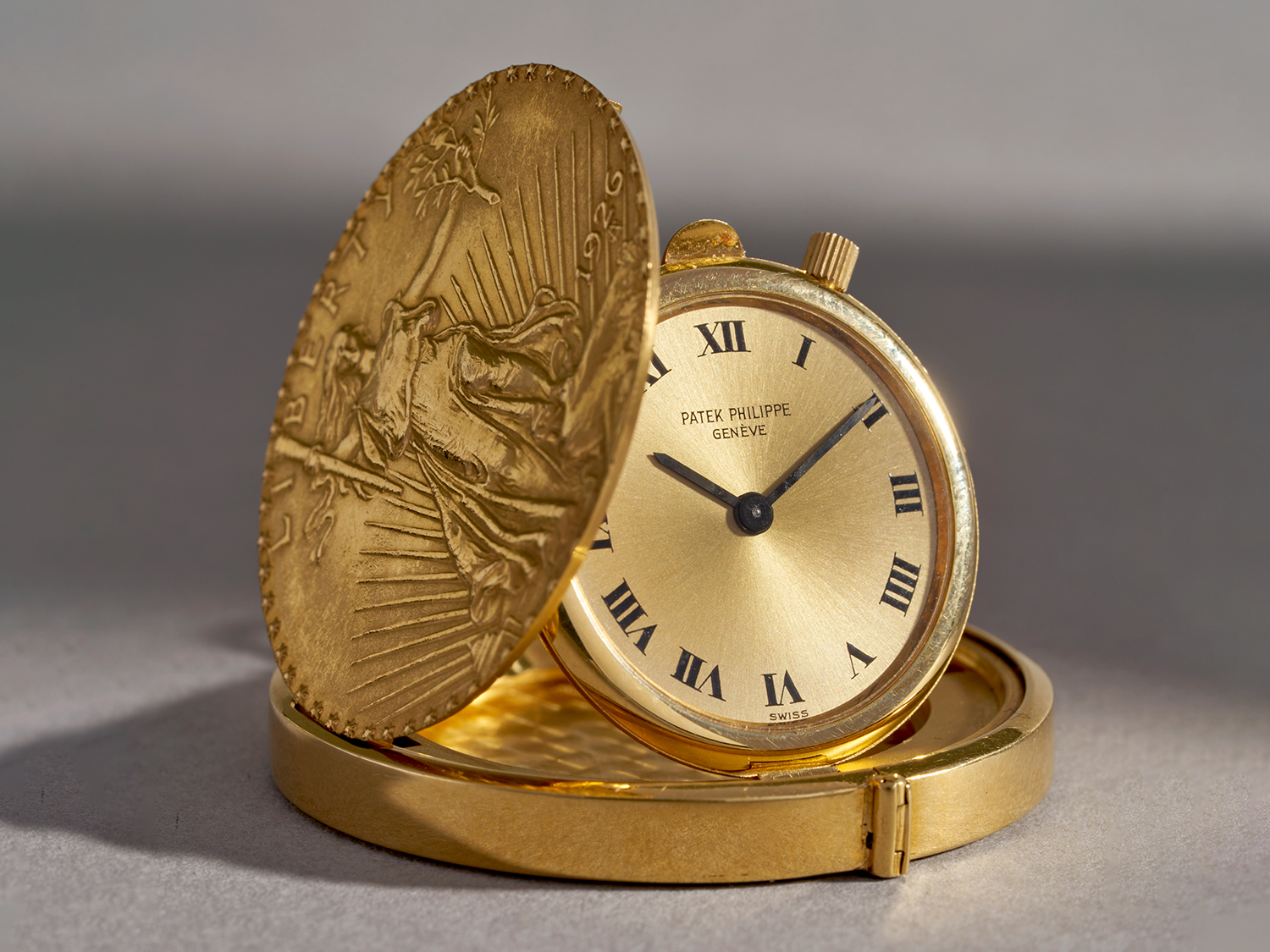
Surprisingly, the answer is yes to both. I first encountered these watches masquerading as coins many years ago whilst working at another auction house and upon seeing one for the first time it appeared to me an opulent magic trick; captivating, playful, and unforgettable.
Just at the very moment you might assume there is little left to surprise in watch design, a seemingly improbable collaboration between horology and numismatics overturns that assumption. Constrained by perhaps 35mm of dial real estate to work with and generally allowing for the non-negotiables of hands and hour markers on an analogue watch, there would be literally thousands of different watches out there and no matter how distinctive they might be they are recognisable as a watch by just about anyone. However, an inquisitive imagination and masterful technical skill merged to create an illusion where an object presents itself as an ordinary gold coin which encloses a near undetectable mechanical timepiece.
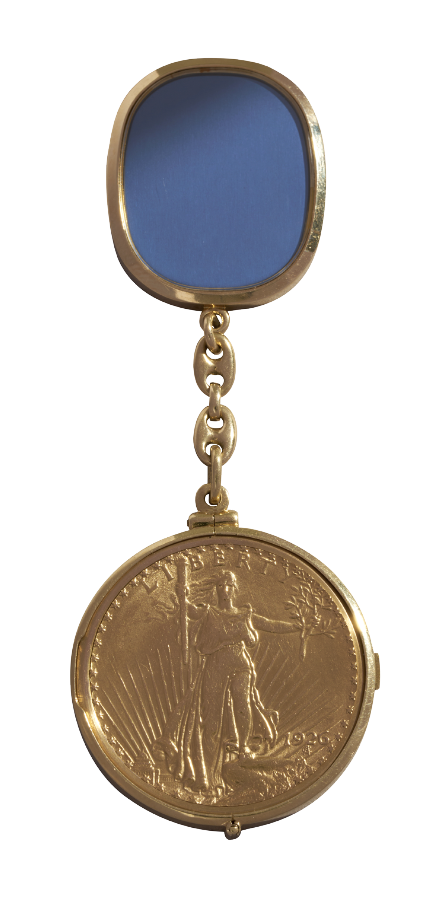
More often than not, these coins would begin as legal tender, it would require a skilled coin maker to dissect two sides, carve an interior to house the timepiece, and finally reconstruct the two sides in a hinged fashion. The gold coin, already an object laden with economic, political, and symbolic meaning, would now become currency for another system of value: timekeeping.
The coin watch genre reached its peak between the 1950s and 70s, a period often regarded as its Golden Age. All the leading Swiss manufacturers would go on to experiment extensively with the form. American $20 Double Eagles proved particularly suitable for case dissection and transformation due to their diameter and gold content. Today, we may look back and think of these watches as ‘stealth wealth’ accessories, outwardly an ordinary gold coin, inwardly a refined mechanical instrument.
Cartier, so often at the forefront of watch design, again played a pivotal role in refining the construction of the coin watch and defining its aesthetic parameters. Central to this development was Joseph Vergely, a salesman-turned-watchmaker whose technical ingenuity proved decisive. It was Vergely who devised the method whereby the coin was split into two sections and a cavity was carefully milled into one half to accommodate an ultra-thin movement, after which the halves were rejoined via a concealed hinge. The coin is divided with minimal material loss; the thinner obverse typically serves as the case back, while the reverse accommodates the movement. The incorporation of ultra-thin calibres, technologically advanced for their time, was essential to preserving the coin’s proportion.
As the coin watch gained prominence, other manufactures adopted and adapted similar constructions, Patek Philippe, Audemars Piguet, Vacheron Constantin, and Jaeger-LeCoultre would all produce their own variation on the numismatic theme. In the later twentieth century, Corum became particularly associated with coin watches, further popularising the form through consistent production.
Yet the enduring significance of the coin watch lies not merely in its brand association, but in its wildly conceptual duality. It embodies two systems of measurement, both treasured: time and money, within the world’s oldest currency and adds to yet another incredible chapter in the story of watchmaking.
Offered in our forthcoming Timepieces auction on 17 August 2026 in Sydney is a rare and unusual Patek Philippe coin watch featuring a 35mm timepiece forged from a United States $20 Double Eagle gold coin, circa 1926, adorned on the obverse with Liberty’s composed grace, and on the reverse bearing the majestic bald eagle. The timepiece features a hinged bezel, triggered by a discreet thumbpiece revealing a satin-finished gilt dial with Roman numerals, all encased in an inner 18ct yellow gold dust cover that safeguards the ultra-slim construction. This watch is part of a small series of gold coin watches, given reference numbers 800 to 809, using the US$5 (Ref. 800), US$10 (Ref. 801), US$20 (Ref. 802 & 803), CHF100 (Ref. 804), Pesos 50 (Ref. 805) and others. No other coin watches have since been made by Patek Philippe.
By Patricia Kontos, Senior Timepieces & Jewels Specialist
Top Image: Patek Philippe Twenty Dollar Liberty Ref 802. A yellow gold coin watch on a gold ‘Ellipse’ key chain, circa 1970. $18,000-24,000
March 2026