The doll automaton is a relic of a world past, both fascinating and disconcerting; often no larger than a coffee table book, modelled with childlike bisque or composite countenance, with expressive large glass eyes and rounded cheeks. Like the development of humanoid robotics we are navigating in the current day, they were animated to realistically simulate human movement, often powered by key-driven clockwork and later electronic mechanics, varying from two to four movements per piece, some synchronic, depending on the complexity of the movement.
With their beginnings in the 17th century, French doll automata saw their commercialisation during the industrial revolution of the 19th century. Their popularity was affected by the industrial shifts, and subsequent commercial changes of the period, resulting in what is known as the golden age of automata, which recorded an increase in annual turnover ten times over in France broadly between 1850 to 1900.
The industrial revolution saw a dramatic shift from artisanal and agrarian industry to machine dominated manufacturing. France embraced the effects of the industrial revolution by the mid-19th century, simplifying manufacturing processes across all industries including the doll and automaton industry. The use of machines to facilitate the construction of the internal mechanism greatly reduced production time and therefore the costs, allowing makers to produce larger numbers to market at a lower price, compared with their earlier examples which required long and patient labour, with a necessity to make each component separately, a process which often would take years to complete.
At the same time, the Universal Exhibitions had given importance to the appreciation of the craftsmanship associated with toy and automaton makers, affording them greater exposure to the emerging middle class, who favoured automata as luxury items; novelties that could be placed in their homes as a representation of their interest in the arts.
Although they present as toys, these wonderful creations were by nature too sophisticated to be intended for children – in addition to their fragility and complex construction, their price tag remained high. The aesthetic aspect was of great importance, like any work of art, there was consideration to the subject, particular movements including the number of movements and how complicated they were, together with the richness of costume and details of the subject’s features; it was the automaton maker’s responsibility to ensure all components were harmonious.
Automata were a true insight into 19th century French society, often modelled on new interests and fashions of the time, such as oriental subjects referencing Japonisme. Some were more flamboyant with examples of magicians, acrobats, and performers, whereas other examples mimicked 19th century middle class life, showing common tasks such as a lady knitting or a child playing with toys.
By the 1890s, in response to commercial demands, automata were introduced to advertising displays to draw the eyes of passersby, and in time became large enough to fill the entire window display. By this point, clockwork movements had become outdated and electrical movements were becoming preferred, for their convenience of a continuous stream of power once plugged in versus its predecessor which required frequent re-winding.
During the early 20th century, production eventually slowed due to multiple factors including restrictive exportation laws for French toys, which was a large portion of the market, and the profound changes in the industry following the end of the First World War.
These fascinating dolls, although produced in large numbers in the 19th century, remain rare in the modern market, often coveted by collectors in multiple quantities and sold privately within niche collecting communities. It is often not until a single collection presents to the public market that we can admire these prized artworks.
I am delighted to present The Parry collection as a feature within our forthcoming Decorative Arts auction on 30 March, which includes approximately twenty examples, varying in maker and theme. Doll automata are all so unique in their creation, so I am sharing three examples here to provide scope on their movement.
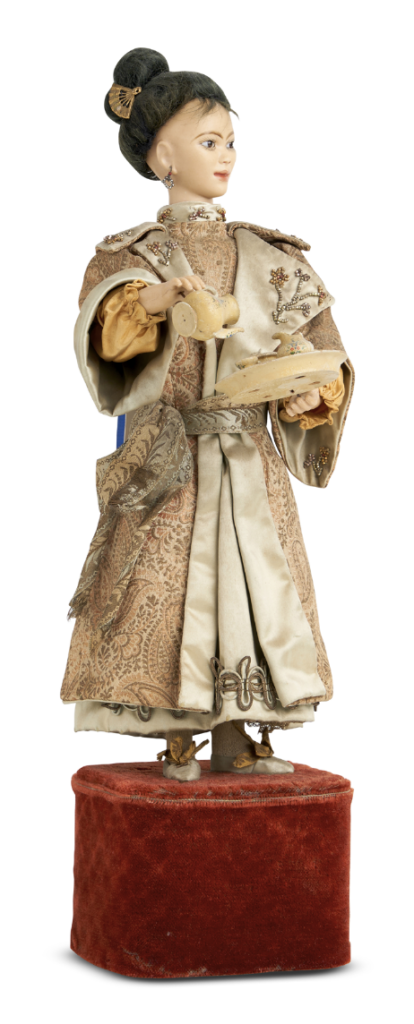
The first example is a musical tea server by Leopold Lambert. When wound, the lady elegantly turns her head then lifts the teapot and ‘pours’ the tea and extends the tray as though serving with music playing throughout.
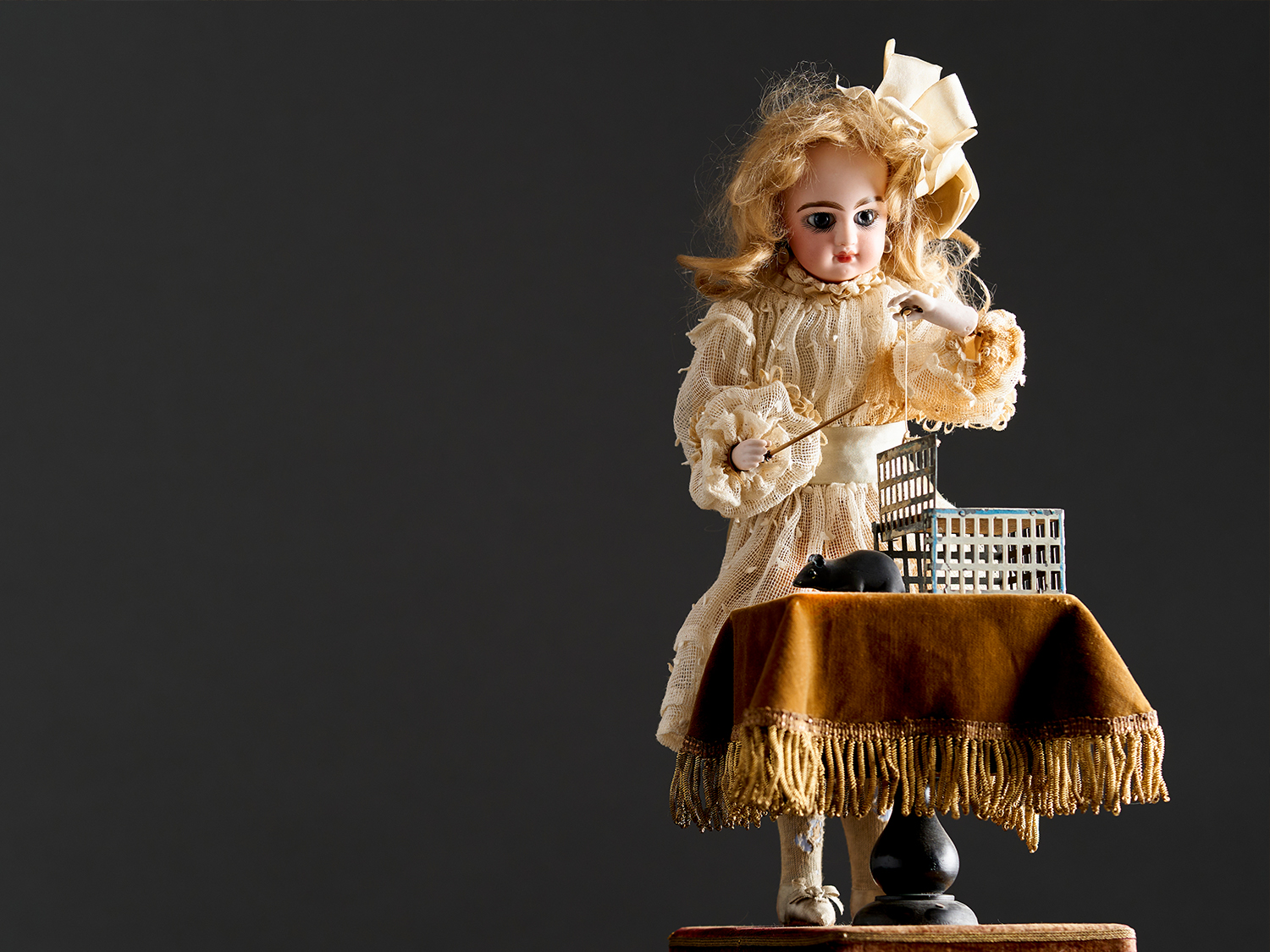
Another example is a musical girl with a pet mouse by Rambou. The little girl holds a baton in one hand and the string to a cage in her other hand. When wound, two mechanisms operate in synchronism; the girl lifts her head and then lifts her left hand to open the door of the cage allowing the mouse to timidly emerge, the girl then taps the mouse with her baton and the mouse returns to the cage, with music playing throughout.
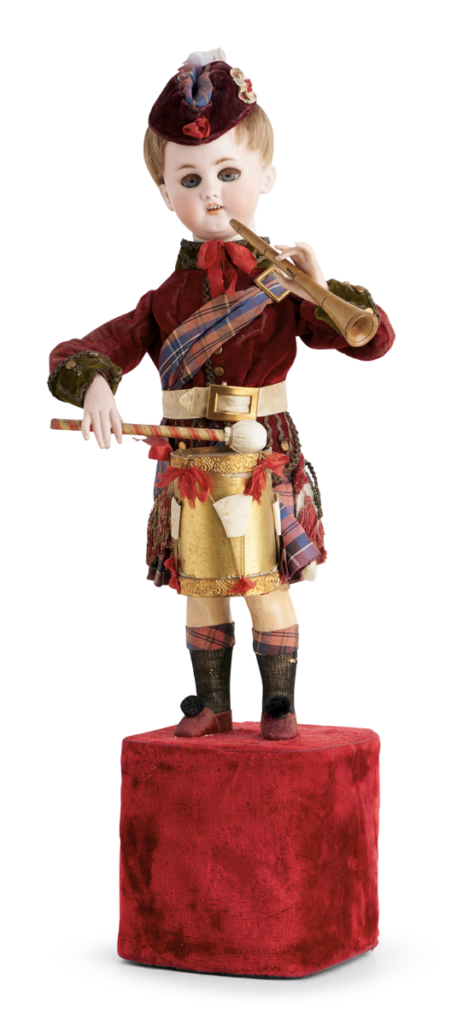
The last example is a musical Scottish boy with drums by Leopold Lambert, when wound the doll turns its head from side to side and nods, the eyes blink, and he brings the horn up as though to play and beats the drum, this example also musical with two tunes.
By Chiara Curcio, Head of Decorative Arts, Design & Interiors
Top Image: A French musical automaton ‘Girl With Pet Mouse’ by Charles Rambour, Circa 1895. $2,000-3,000
February 2026